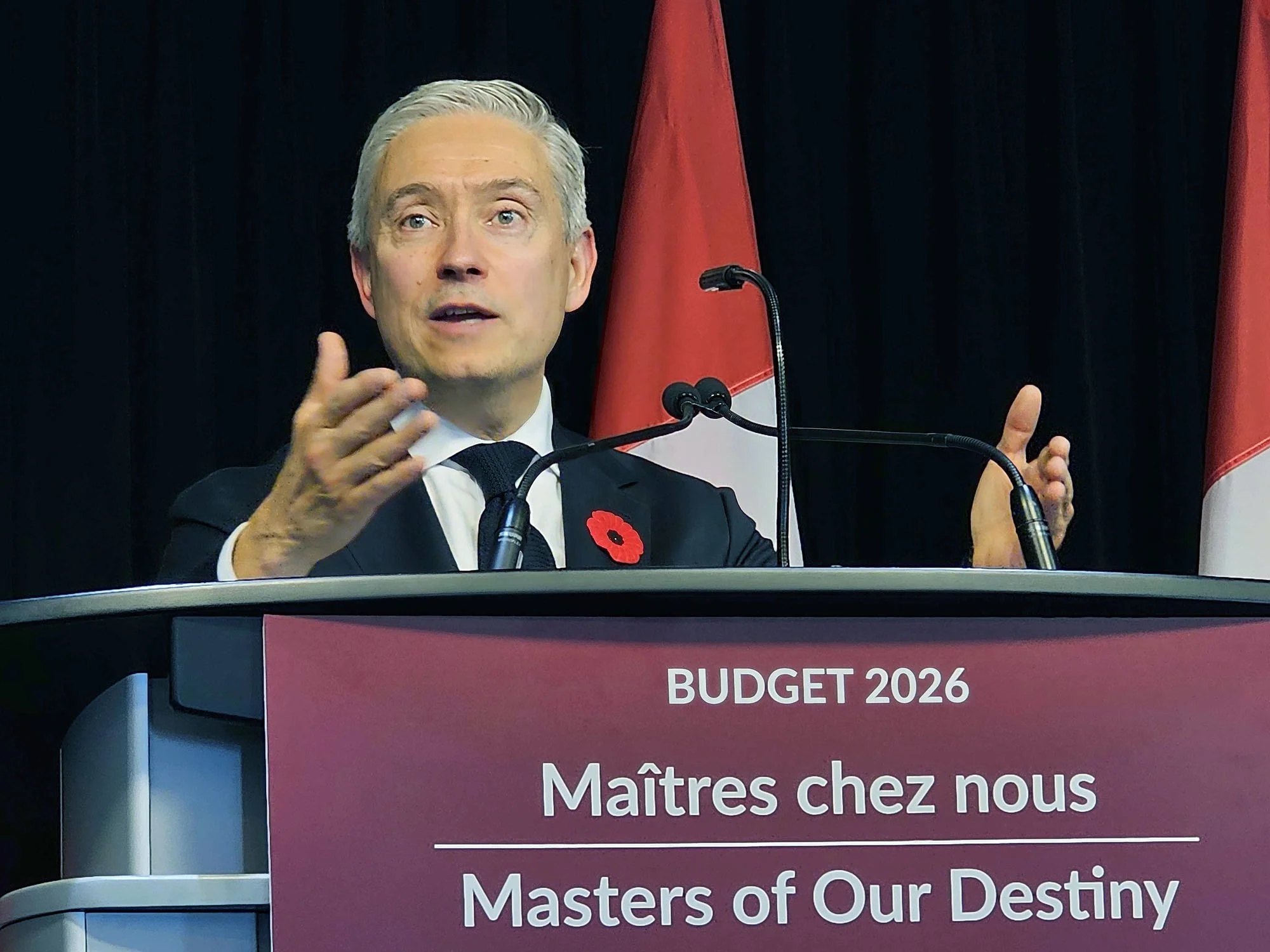
‘I think Canada understands we need to do more to build this country. We're going to do that together with measures which will support growth,’ says Finance Minister François-Philippe Champagne. / MEANS & WAYS PHOTO
Canada's latest federal budget delivers a major injection of investment spending while maintaining a relatively stable fiscal outlook, a combination that could help strengthen economic growth and productivity, says Scotiabank Vice-President Rebekah Young.
“What we saw is a massive saving and a massive spending,” Young told Means & Ways in an interview. “They’ve put a lot of money on the table. It's a government clearly focused on investment, but also … a bit of a reality check of our society today that unfortunately has left many falling through the cracks.”
The government is investing $151 billion in new spending to “reinforce Canadian sovereignty” and to build “a stronger, more independent economy,” according to the 2026 budget, tabled today.
The budget, titled Masters of our Destiny, shows a $62.3 billion deficit this year, an increase of $23 billion from 2025-2026 but lower than the Spring Economic Update projection of $65.3 billion. The debt has increased by $60.4 billion. Finance Minister François-Philippe Champagne says, however, that Canada’s economic foundation remains strong.
“You can always look at things in absolute, but if you want the real picture, you have to look at what's the borrowing cost of our G7 partners,” Champagne told media during the budget lockup. “I think if you look at the trajectory of Canada compared to the other G7 countries, that would give you the confidence that the market has confidence in Canada.”
He noted that Canada, along with Germany, are the only two G7 countries with a triple-A credit rating but compared to Germany, Canada’s debt to GDP ratio is much lower. Canada’s ratio is 9.3, whereas Germany’s is “around 50,” he said.
“We are by far in the strongest fiscal position of the G7, and if you look at the fact that the economy will reach $4 trillion by the end of the decade … you see that we're in a very strong footing, and everything is in proportion.”
Balancing ambition and risk
The 511-page budget focuses on making it easier for the private sector to invest in Canada. It formalizes the Productivity Mega Deduction and the Canada Strong Fund, announced following the Canada Investment Summit.
“Budget 2026 [is] the most comprehensive revamp of business incentives in generations. At the heart of it, is the new Productivity Mega Deduction, which will boost Canada’s Investment Supercycle,” Champagne said in his remarks in the House of Commons. “Businesses, both large and small, will be able to immediately deduct the full cost of most new investments.”
The government projects that this will add $22 billion a year to the GDP and create up to 80,000 jobs over the next decade.
“We are making it easier for businesses to choose Canada,” Champagne said.
Lisa Raitt, CIBC Vice-Chair, Office of the CEO, told Means & Ways the government is “taking on a fair amount of risk - both politically and fiscally - in putting these measures in place.”
“The budget has two masters it seeks to serve. The first is the average Canadian family struggling with affordability and needing some assistance. The second is the general economy, which suffers because of poor productivity,” she said. “There are plenty of measures that are dedicated to each of these masters. … We won't be able to measure success in the short term. Canadians will have to give this government a fair amount of room.”

‘The underlying message here is meant to send certainty to markets, certainty to investors,’ says Compass Rose managing director and chief strategy officer Marci Surkes. / SUBMITTED PHOTO
Compass Rose managing director and chief strategy officer Marci Surkes said the budget builds on previous announcements and without any marquee pieces or central policy plank, it focuses on running government like a business.
“This is a budget that is designed not to please from a retail perspective; it is a budget that is designed to ensure that the country's largest business is functioning, that they are streamlining operations, that the efficiencies are being found,” she told Means & Ways. “We see from a structural perspective that the government is going to be carrying incredibly high debt servicing. Coming up to a trillion dollars [of debt] is a major milestone in terms of what Canada has borrowed and what Canada is going to have to repay. These are significant markers on our GDP. At the same time, the underlying message here is meant to send certainty to markets, certainty to investors.”
With a majority government, the Liberals have determined that retail politics is not a priority at the moment, but rather putting in the fundamentals for a strong, sovereign Canada in the face of threats to the economy from the U.S. is paramount. Prime Minister Mark Carney’s high popularity in terms of how he is handling “the existential crisis with the Trump administration and tariffs” means the government is able to take this tougher decision, Surkes said.
“They can be focused on advancing the plan, more so than currying political favour,” she said, noting that the government acknowledged the affordability crisis minimally, for example, by extending the Groceries and Essentials Benefit Supplement or providing Build Canada Homes more funding to build more houses. “I do think overall Canadians sitting around their kitchen table, who are feeling the pinch of the high cost of gas, diesel, who are watching their grocery bills increase, that these measures may be seen as lacking. The government is going to have to try to find that balance a little bit better as it moves forward.”
‘Stronger growth could also bring challenges’

“They’ve put a lot of money on the table. It's a government clearly focused on investment.”
— Scotiabank Vice-President Rebekah Young
Young said the investment measures could generate a stronger economic response if global uncertainty eases, particularly if trade tensions diminish and international policy conditions stabilize.
That could create an economic outlook considerably more optimistic than the one reflected in the government's budget projections.
“We could have the Canadian economy rebounding a lot more quickly than the budget baseline shows,” she said.
However, stronger growth could also bring challenges.
She cautioned that a simultaneous rebound in private-sector activity and a surge in construction of government-backed major projects could put pressure on labour markets, building materials and construction capacity.
Policymakers should consider not only the risks of weaker economic conditions but also the possibility that the investment agenda proves more successful than anticipated, she said.
“I feel like there’s a need for a pivot from thinking about all the bad things that can happen to thinking about what the problems are if all the good things happen,” she said.
Incentivizing businesses reinvestment
The $25-billion Canada Strong Fund will invest in nation-building projects and high-growth Canadian companies on the same commercial terms as the private sector. It will be an independent organization and take minority ownership positions. The fund will be open to Canadians to also invest in by buying “Canada Strong Notes” through their participating financial institutions.
The budget also introduces a Canada Growth Incentive that provides up to $15 million in tax exemptions for capital gains and allows small businesses to defer taxes on capital gains if reinvested in another Canadian small business.
“These measures will help level the playing field with the United States, encourage more capital to flow to Canadian businesses, and enable successful entrepreneurs to reinvest their proceeds into Canada,” the budget says, noting it will provide $715 million in tax relief over four years.
Matthew Holmes, Executive Vice President and Chief of Public Policy at the Canadian Chamber of Commerce, welcomed the investments.
“This is a step change in how the government is incentivizing the kind of business investment and reinvestment Canada needs,” he said in a statement. “The real report card for this budget will come from boardrooms, factory floors and small businesses deciding that Canada is worth their next investment. Based on what we’ve seen, this Budget sets the stage for entrepreneurs and business owners to consider starting or growing their business here at home.”
Holmes noted, however, that he worries about the government’s fiscal discipline. “We are concerned that public debt charges are the fastest growing component of federal spending, and over time this will seriously limit what capacity the government has for services and new initiatives. With a projected $62.3-billion deficit and increasing borrowing costs, Ottawa must remain committed to its economic growth strategy as a way to mitigate this risk. If we can't, this will become a fiscal shackle,” he said.
Young said that Canada’s fiscal situation is an “outlier” compared to its advanced economy peers. “The fiscal trajectory hasn't materially changed. If you look at the deficit and the debt profile as a share of GDP, they actually show modest improvement over the medium term,” she said. “They are paying more in debt service charges, but still, debt and deficit trajectories are bending down, and they're bending down modestly sharper than they were in the springtime. But I would say, I don't think they can be complacent because there are a lot of exogenous factors that can drive interest rates.”
Meanwhile, the government is also making significant changes to the tax system, including:
Reducing the marginal effective tax rate from 13% to 6.4%;
Extending the Mineral Exploration Tax Credit and Critical Mineral Exploration Tax Credit;
Making the Canada Caregiver Credit fully refundable; and
Changes related to the Registered Disability Savings Plan, a Medical Expense Tax Credit, a Home Accessibility Tax Credit; Adoption Expense Tax Credit and a Labour Mobility Deduction for Tradespeople.
Champagne described it as “the most ambitious effort in decades to simplify Canada’s tax system.”
Positioning Canada to compete globally
On defence and security, the government is investing $2.3 billion in a Defence Drone Initiative, $7.6 billion as part of NATO to deter Russian aggression in the EU, and $2.7 billion for quantum and space capabilities.
“At a time when the world is more dangerous and divided, Canada is rebuilding its Armed Forces. We are investing in the capabilities we need to defend our country, particularly in our North and Arctic. And we are strengthening our defence industry here at home, so that Canada makes more of what our Forces, and our allies, need to do the job,” Champagne said.
On making government operations and services more efficient, the budget makes a $1 billion investment to establish a Government Transformation Fund “that will accelerate transformative Information Technology (IT) projects to improve service delivery for Canadians and help make the public service more productive.” The government will also soon introduce the Digital Transformation Canada Act that establishes “a legislative framework for the delivery, governance, and management of digital and information technology services and capabilities across the Government of Canada.”
The government also wants to modernize the payments system and increase competition in the banking sector to “encourage the entry and growth of mid-sized challenger banks” by exempting foreign bank subsidiaries with less than $8 billion in equity from the public holding requirement.
The budget also makes investments in the electricity grid, including extending the Clean Technology and Clean Electricity investment tax credits, supporting infrastructure expansion, new funding for the Smart Renewable and Electrification Pathways Program, funding for data and modelling capacity and updating the Clean Electricity Regulations. The government is also investing $6 billion to help deploy emerging electricity generation technologies, in addition to installing 55,000 EV chargers. More than $518 million will be invested in nuclear research, supply chains, workforce, and regulatory capacity.
Champagne said the budget will increase Canada’s global competitiveness while ensuring that the country remains sovereign. “The world around us is changing. We must change to lead with purpose and ambition,” he said. “We must have confidence in what Canada can become. We must build at an unprecedented speed and scale. We must take care of one another. We must defend our sovereignty. With this budget, we will build the strongest economy in the G7.”
Young said while the budget provides “one more data point that the government will continue on this investment agenda,” execution will be key. “They're kind of moving at a pace of credibility, but they're convincingly showing that they're going to continue to put more capital on the table as evidence grows that it's working, and consequently, as markets embrace this approach,” she said. “The price government is willing to pay for sovereignty is maybe way higher than markets would clear and so they are adding more and more incentives to see what it would take to get private sector to the table.”
Snapshot of Budget 2026 by the numbers
$36 billion over five years to reduce the marginal effective tax rate from 13% to 6.4%
Up to $15 million in tax exemption for capital gains earned from successful investments in eligible Canadian companies
$930 million to expand the SR&ED tax incentive program to include certain commercialization expenses.
$1 billion over six years to the Strategic Response Fund to support large-scale research and development and innovation projects
$181.4 million over four years to expand Invest in Canada to add specialized financial sector expertise and establish its presence in key global markets; deliver Canada’s future Investment Summits.
$37.6 million over three years to develop concession framework for private sector investments in airports
$4.3 million to develop a Traveller Biometrics Strategy.
$2.4 billion from 2027-28 to 2030-31 and $36.1 billion from 2031-32 to 2041-42 to extend the Clean Technology and Clean Electricity investment tax credits to the end of 2040.
$4 billion over 10 years to support electricity infrastructure expansion, renewable energy, and priority electricity sector projects across Canada, including new funding for the Smart Renewables and Electrification Pathways Program
$26.4 million to Natural Resources Canada for data and modelling capacity and improve system planning
$22.9 million to Environment and Climate Change Canada to update the Clean Electricity Regulations and to develop equivalency agreements with provinces and territories where appropriate.
$6 billion to support the deployment of emerging electricity generation technologies.
$518.5 million to advance Canada’s nuclear research, supply chains, workforce, and regulatory capacity.
$587 million to support the installation of over 55,000 additional EV chargers
$45 million to fund research and development for charging infrastructure to help bring innovative Canadian EV charging solutions to market, delivering more affordable, reliable, and accessible EV charging solutions
$2.2 million to renew the Greening Government Operations Fleet Program
$424.4 million to renew the Canadian Critical Minerals Strategy
$956 million to extend the Mineral Exploration Tax Credit and Critical Mineral Exploration Tax Credit for an additional five years
$54 million in tax relief for the helium exploration and development sector
$500 million to strengthen fibre supply chains and support provinces, territories, Indigenous partners and industry in advancing forest management and stewardship, and deploying new technologies and practices.
$2 billion to help businesses in the forest sector modernize facilities and equipment, improve productivity, and expand production of higher-value products, as well as to support research, development, and demonstration projects.
$4 billion over six years to support a new Forestry Sector Accelerator to make investments in new large-scale facilities and in major transformations of existing facilities, including biorefineries, biofuel facilities, and other facilities producing higher-value and innovative forest products.
$400 million to support the renewal of the Green Industrial Facilities and Manufacturing Program, now named the Strategic High-efficiency Industrial Facilities Transition (SHIFT).
$187.4 million to launch and operate a major projects management entity and begin support for the Mackenzie Valley Highway and the Taltson Hydro Expansion project.
$176.9 million to renew the Wine Sector Support Program.
One-time 50% increase to enhance the Canada Groceries and Essentials Benefit Supplement
$610.3 million for Nutrition North Canada
Extending the Canadian Journalism Labour Tax Credit to qualifying private audio and audiovisual news organizations of 35% and annual labour expenditure limit of $85,000 per employee; renewal of the temporarily enhanced 35% credit rate until December 31, 2028 for print media
Introduce the Build Canada Workers Benefit, lowering the minimum earnings threshold from $3,000 to $500, and from $1,150 to $200 for the disability supplement.
$845 million to make the Canada Caregiver Credit fully refundable
$11.2 billion, over 4 years, starting in 2027-28, and $17.8 billion in future years to end homelessness in 10 years, including $5 billion for a new Integrated Supports Fund delivered through Build Canada Homes and $10 billion for supportive and transitional housing; $2 billion for Health Infrastructure Fund to address mental health and substance use contributing to homelessness; $6.5 billion to renew Reaching Home initiative and Veterans Homelessness Program for 10 years; renewing Canada Housing Benefit for 10 years of $5.6 billion
$1.7 billion to renew the Canada Housing Benefit for 10 years
$13 billion over 10 years to boost the capital of Build Canada Homes to deliver 200,000 new homes
$1.5 billion to prepare federal lands for housing by funding water, wastewater, roads, and other enabling infrastructure.
$100 million over three years toward a partnership with the Federation of Canadian Municipalities to support municipal e-permitting and the adoption of artificial intelligence, enabling more efficient and effective review and approval processes, to get homes built faster.
$300 million for the Strategic Response Fund to build and expand industrial capacity to accelerate the adoption of modern methods of construction and help lower construction costs.
$67.7 million to improve the efficiency of the homebuilding sector, accelerate home construction, and increase housing supply
$101.2 million in future years to modernize housing data and establish common standards for modern methods of construction.
$51 billion for the Build Communities Strong Fund to speed up the construction of the hospitals, recreation centres, universities, and colleges
$6.9 million to extend Inclusion Canada’s Ready, Willing and Able initiative
$124 million to renew the Local Food Infrastructure Fund to help food banks and other national, regional, and local organisations buy food and invest in community food infrastructure.
$100 million to renew Health Canada’s Emergency Treatment Fund to respond to urgent substance use and overdose needs, including mobile outreach, naloxone distribution, and land-based healing programs in municipalities and Indigenous communities
$10 million for the Praxis Spinal Cord Institute to support turning health research into new medical treatments.
Amend the Employment Insurance Act to temporarily increase the minimum number of Employment Insurance regular benefit weeks from 14 to 18 weeks for apprentices who take full-time training, at an estimated cost of $5 million over four years, starting in 2027-28, and $1.1 million in future years.
$451.8 million to launch
$170 million for the Workforce Tariff Response to ensure that workers can continue to benefit from targeted training and employment services delivered in partnership with the provinces and territories
$56.9 million over four years, starting in 2027-28, with $205.4 million in future years to implement the 2027-2029 Immigration Levels Plan, which aims to bring in 370,000 new temporary residents and 380,000 permanent residents
$302.3 million over four years, starting in 2027-28, with $90.6 million in future years to help transition temporary residents to permanent residents
$151.5 million over five years, starting in 2026-27, to reform the Temporary Foreign Worker Program to better align with regional labour market needs, in collaboration with provinces and territories, improve processing time and strengthen employer compliance.
$300 million in 2027-28 for the Canada 160 Fund, a suite of programs that will support the stories, spaces, and experiences that bring Canadians together.
$10 million in 2027-28 for the Building Communities through Arts and Heritage program
$15 million for the Canada Arts Presentation Fund
$1.5 billion over nine years through the Build Communities Strong Fund to support the construction, expansion, retrofit, and rehabilitation of community recreational facilities and ice rinks across Canada. This includes $750 million for the ice rinks and $750 million in additional funding for other community recreational facilities.
$76 million to renew Canada Strong Pass.
$46.3 million over five years, starting in 2026-27, and $11.5 million ongoing to Canada’s national museums and the National Battlefields Commission to permanently make admission to Canada’s national museums free year-round for children and youth under 25.
$783.1 million over five years, on a cash basis, starting in 2026-27, to support Canada’s national museums, the National Battlefields Commission, the National Arts Centre, and Library and Archives Canada to help repair and renew aging facilities, protect national collections, and sustain the exhibitions, performances, and services that connect Canadians to our history and culture.
$60 million to the National Gallery of Canada to expand opportunities for Canadians to access and engage with Canada’s arts, culture, and heritage, both in person and online.
$32.2 million over four years, starting in 2027-28, and $9.5 million in future years, to make it easier for Canadians to discover and borrow books by Canadian authors by establishing a free national digital collection.
$20 million over four years to renew the Canada Book Fund
$18.5 billion over 10 years to improve First Nations infrastructure on reserve
$226.7 million over 10 years, starting in 2027-28, to the Atlantic First Nations Water Authority to maintain water and wastewater services in 13 First Nations communities in New Brunswick, Prince Edward Island, and Nova Scotia, and allow it to plan major capital projects that would expand services.
$11 billion over 10 years, starting in 2027-28 to improve First Nations housing
$8 million over four years, starting in 2027-28, and $2 million ongoing to support organizations working to advance equality for women and address systemic barriers through the Women’s Program, including projects that support women entrepreneurs, increase women’s representation in leadership roles, and help address gender-based violence.
$70 million over two years to the Menstrual Equity Fund.
$14.9 million over four years, starting in 2027-28, with $5 million in future years to support research on women’s health through the National Women’s Health Research Initiative.
$136.3 million over four years for Canada’s Black Justice Strategy.
$2.3 billion over five years, starting in 2027-28, on a cash basis to the Department of National Defence for the Defence Drone Initiative to accelerate the discovery, acquisition, and deployment of uncrewed and counter-uncrewed capabilities.
$7.6 billion over five years, starting in 2026-27, on a cash basis to the Department of National Defence and Global Affairs Canada for the extension and expansion of Operation REASSURANCE, Canada’s largest overseas deployment mission to deter Russian aggression on NATO’s Eastern Flank and fortify our shared European defence,
$2.7 billion to advance Phase 2 of the Canadian Quantum Champions Program, expand the Launch the North initiative to establish a sovereign, medium-lift Canadian space launch capability, and further develop Canadian space technology by helping firms scale up development and capacity for launch in space missions.
$6.0 billion over 10 years, starting in 2027-28, on a cash basis, and $579.5 million ongoing to CSIS to engage with Canadians in their communities; better protect Canadians from terrorism, foreign interference, espionage, and other evolving threats; and reduce reliance on foreign partners.
$176.3 million over five years, starting in 2026-27, and $29.3 million ongoing to Canadian Heritage to establish the new Digital Safety and Data Protection Commission of Canada to create a safer online space for Canadians.
$6.2 million over four years, starting in 2027-28, to support Canada’s continued participation in the Global Partnership on Artificial Intelligence via the International Centre of Expertise in Montréal on Artificial Intelligence.
Canadian AI companies will be able to access 500 MW of sovereign AI compute through new financial tools, such as backstops and offtake agreements, to mobilize private capital and expand compute capacity.
$192.5 million over four years, starting in 2027-28, and $42.5 million ongoing to the Canada Border Services Agency in support of modernizing and stabilizing critical border technology infrastructure.
$1 billion over five years to establish a Government Transformation Fund that will accelerate transformative Information Technology (IT) projects to improve service delivery for Canadians and help make the public service more productive.
$17.6 million over five years, starting in 2026-27, and $4.2 million in 2031-32, to establish a Fellowship Program through Build Canada Exchange to recruit technical experts, professionals, and academics to support priority projects.