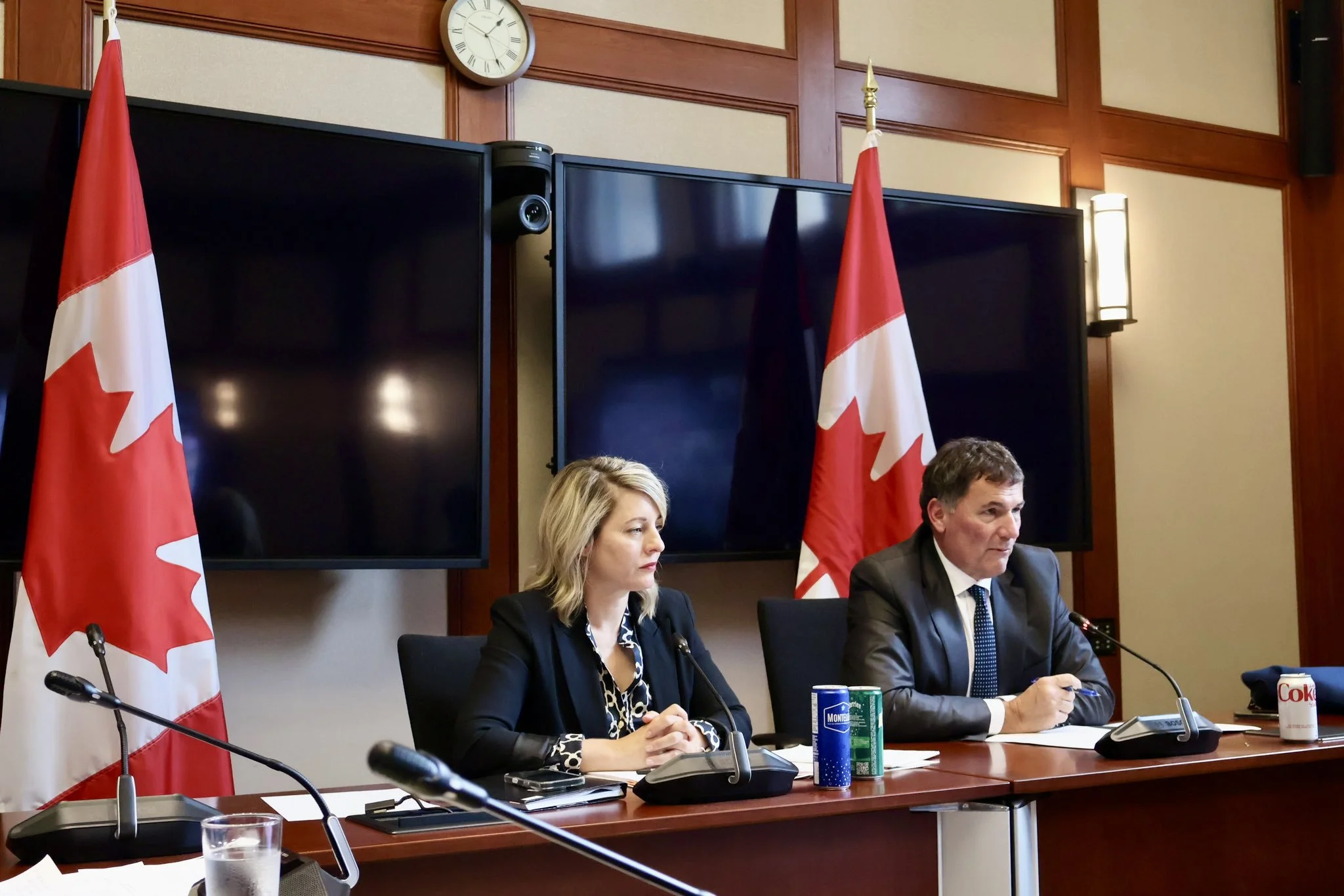
Canada-U.S. Trade Minister Dominic LeBlanc, pictured with Industry Minister Mélanie Joly, pictured a meeting with members of the Advisory Committee on Canada-U.S. Economic Relations in September. / TWITTER PHOTO
Canada will continue to diversify its global trade, even though Democrats swept the House and Senate in the U.S. midterms this week, Prime Minister Mark Carney says.
“Obviously, we welcome any moves to restore a free trading arrangement between Canada and the United States, which is in the interests of American families struggling with affordability,” Carney said. “It’s in the interests of American workers looking for good, high-paying jobs and stability, and it’s fundamentally in the interests of Canadians. And we will continue to work with the Americans to get a deal that works for Canada.” Carney confirmed he hadn’t spoken to any Democrats on the tariffs.
Canada-U.S. Trade Minister Dominic LeBlanc recently told reporters the political map change in the U.S. won’t “change the work that we have to do in the next two weeks. The American Congress will act in the interests of the American Congress. Our work will be focused on what we can do here at home.”
Finance Minister François-Philippe Champagne also similarly shifted the focus to Canada, even after Carney acknowledged on Tuesday that lines of communication had opened with the U.S. earlier this week, with the Americans “asking less” and “offering more.”
The trade war emerged as an election issue in northern battleground states, including Maine and Michigan, where Republican candidates distanced themselves from Trump's tariffs on Canadian goods.
In Maine, Republican Senator Susan Collins lost her re-election bid despite Trump's decision to ease some tariffs on Canadian products.
Conservative Leader Pierre Poilievre said the results sent a clear message about American opposition to tariffs.
"A tariff on Canada is a tax on Americans," Poilievre told reporters Wednesday.
"What (Carney's) got to do is take advantage of the immense leverage that Canada has had all along with the goodwill of the American people to get tariff-free trade with our biggest market in the world."
Democrats could introduce legislation challenging Trump's trade measures and increase scrutiny of his administration, but they lack the two-thirds congressional majorities required to override a presidential veto.
House Democratic leader Hakeem Jeffries has promised legislation to "stop the stupid Trump tariffs jacking up prices on Americans."
Trade experts also caution that protectionist sentiment extends across party lines, making a complete reversal of American trade policy unlikely.
Drew Fagan, a professor at the University of Toronto's Munk School of Global Affairs, said the election results were encouraging but would not immediately resolve Canada's problems.
"It's finally, after a decade of Trump, hard pushback against his abuse of American democracy. That's got to be a good thing and good for Canada being on its border. But it doesn't mean that the trade stuff solves itself overnight," he said.
Beyond tariffs, Democratic control of Congress could influence American climate policy, electric-vehicle incentives and regulation of artificial intelligence and data centres, with potential consequences for Canadian investment.
For Ottawa, however, the immediate priority remains securing relief for industries facing American duties while maintaining a longer-term strategy to reduce dependence on the U.S. market.
Fen Hampson, a Carleton University international affairs professor, warned that expectations should remain modest.
"But we should not expect tariffs to disappear. The question is how much will they go down and will it be enough to keep our key industries alive or, at the very least, on life support."