‘It’s not a one‑way street,’ LeBlanc says about CUSMA negotiations
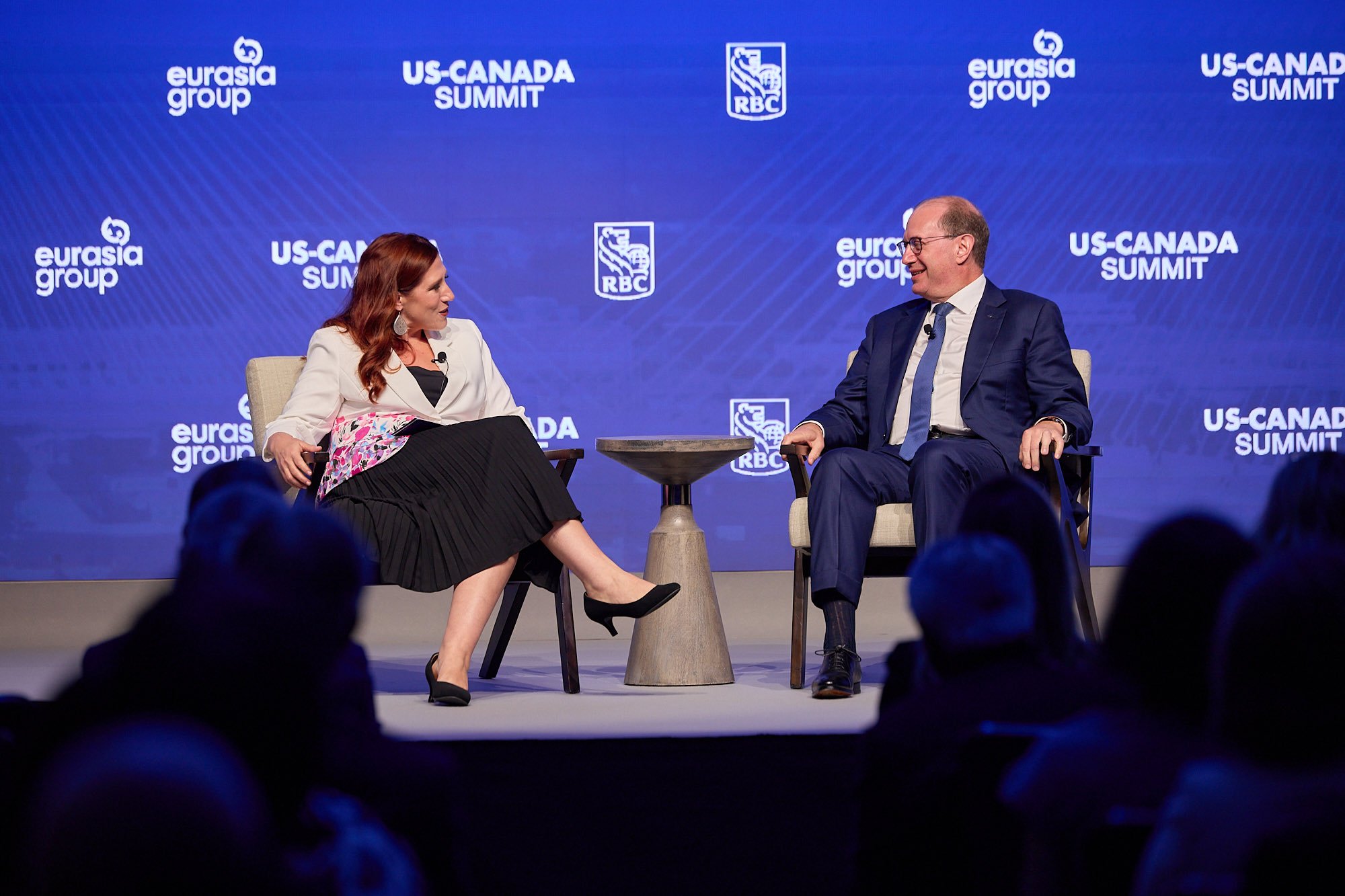
Canadian American Business Council CEO Beth Burke spoke to Canadian Ambassador to the U.S. Mark Wiseman at the RBC-Eurasia Group US-Canada Summit on June 11. ‘We are living in an uncertain world,’ he said. / TWITTER PHOTO
Despite U.S. President Donald Trump stating he’s “not looking to renew” the Canada-U.S.-Mexico free trade agreement, Minister Dominic LeBlanc said there’s a desire from the Americans “to get us on a track” toward bilateral discussions that would run alongside the broader trilateral process.
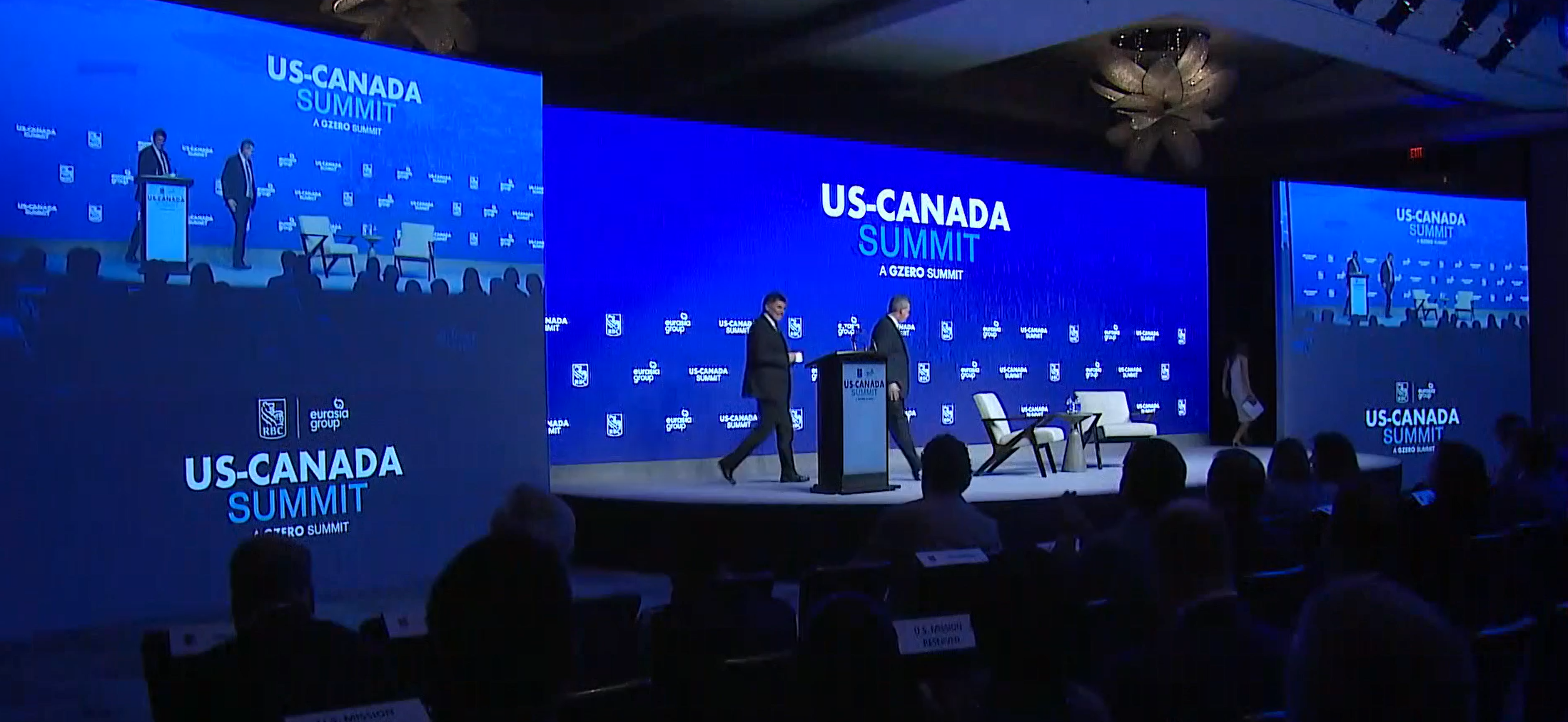
“We’re doing the important work of answering some of the longstanding concerns that the United States has publicly spoken about in terms of non-tariff barriers,” LeBlanc said at the RBC-Eurasia Group U.S.-Canada Summit in Toronto on June 11.
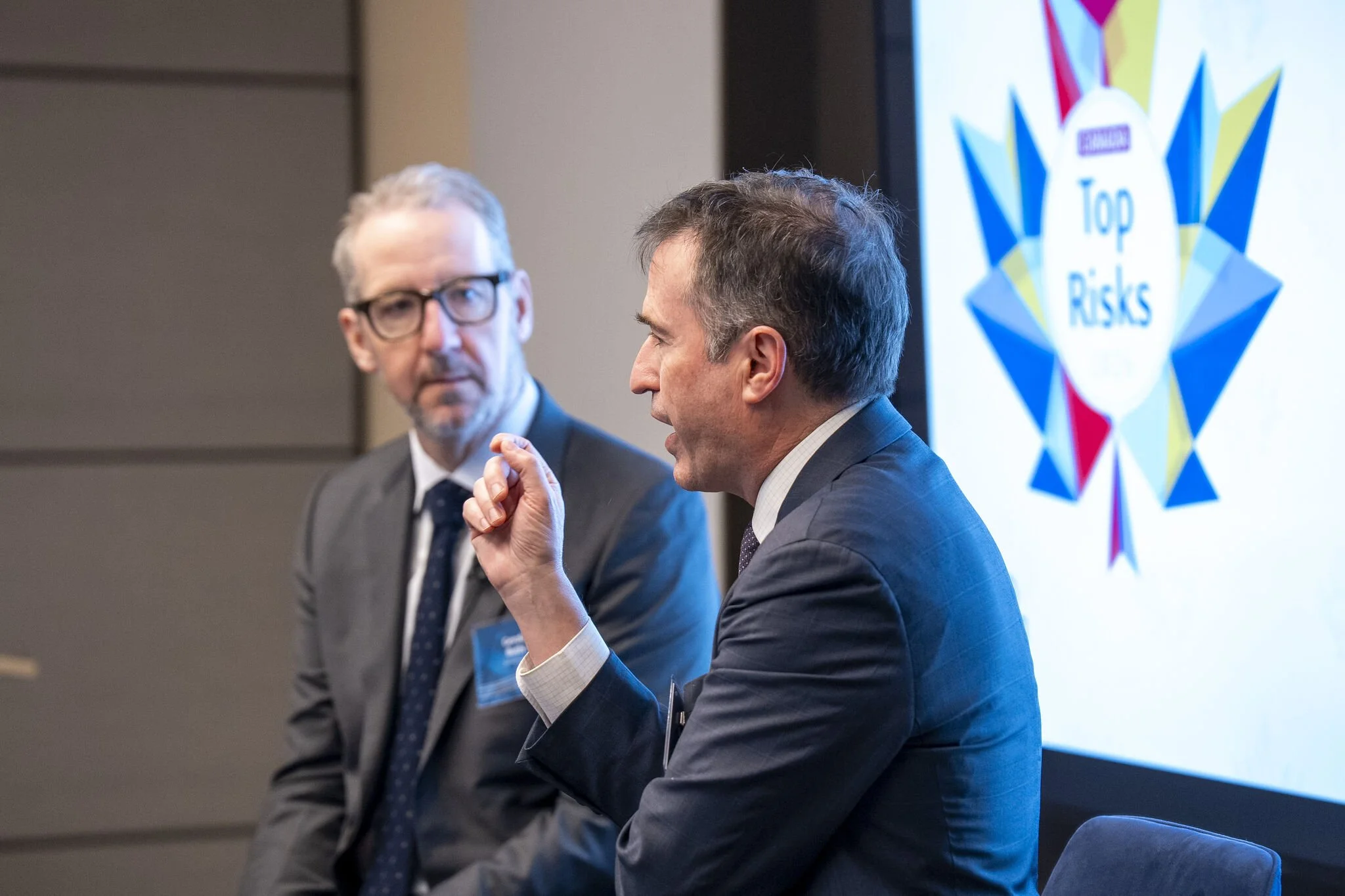
LeBlanc said there was progress in the negotiations on longstanding U.S. concerns around non‑tariff barriers. In a conversation with Canada‑U.S. relations expert Christopher Sands, LeBlanc said he Chief Trade Negotiator and former PCO clerk Janice Charette met last week with U.S. Trade Representative Jamieson Greer and Deputy Assistant U.S. Trade Representative Jeff Gettman to review “well over” a dozen items raised in the United States’ annual trade‑barriers report. He said Canada has addressed many of the issues identified by Washington, including several that align with Canada’s own economic interests.
“It’s not a one‑way street,” he said, adding that Canada has also raised its own priorities in the relationship.
Trump said Wednesday: “I made the deal and the primary reason I made the deal is that NAFTA was the worst trade deal I’ve ever seen,” he told reporters. “Yeah. And I made it better. But I had the right to terminate.”
Beyond that, the closed-door negotiations on the future of CUSMA in Washington were infused with new urgency when the Trump administration apparently blocked the long-awaited opening of the $6.4-billion Gordie Howe bridge between Windsor and Detroit.
Prime Minister Mark Carney had said the ribbon-cutting ceremony for the new structure — which was paid for by Canada — would be held on Friday. But Trump intervened to block the opening.
“We are working hard to make sure the bridge is open as soon as possible,” Carney said when news of the hold-up came out. “There is no big drama. If it takes a little longer, it will take a little bit longer, but this will benefit Canadians, Americans, businesses, tourists.”
After contact with the American owner of the competing Ambassador Bridge in February, Trump said the U.S. would need to be compensated before he would allow the bridge to open. His position has not shifted, U.S. officials said this week.
Pressed on renewed “51st state” rhetoric from Trump, LeBlanc cautioned that Canada should not be “emotionally vested” in U.S. domestic political messaging. He said Ottawa’s focus remains on protecting long‑term economic interests and maintaining a stable trading relationship with both the United States and Mexico. “American political leaders will prosecute their domestic American politics in the way they choose,” he said.
July 1 not a deadline
LeBlanc also downplayed the significance of the July 1 CUSMA review date, calling it a procedural moment rather than a deadline. He noted the agreement remains in force for another decade even without an immediate extension. Technical discussions between the United States and Mexico are scheduled for July, and LeBlanc said the three countries could agree to extend the pact at any point thereafter. He added that bilateral arrangements may emerge alongside the trilateral framework if they help resolve outstanding issues.
Earlier in the day, U.S. Ambassador Pete Hoekstra and Canada’s Ambassador to the United States, Mark Wiseman, highlighted the depth of North American economic integration and the opportunities both countries see in strengthening supply‑chain and security cooperation.
Hoekstra hit an unusually positive note on bilateral relations and future trade cooperation.
“We want a strong Canada,” he told the US-Canada Summit.
Contrary to the anti-Canada trade refrain Trump repeated on Wednesday, Hoekstra said the U.S. does need exports and integrated trade with Canadians. He said Trump is a businessman and the president’s negative expressions about trade with Canada should be seen as his way of saying “make me an offer.”
Hoekstra pointed to cross‑border work on manufacturing, energy, advanced technologies and law enforcement. He urged Canada to take an assertive approach in upcoming negotiations, arguing that shared standards and integrated supply chains make Canada a natural partner for U.S. industry. “If America needs a single car coming into the United States from somewhere else in the world, the best place to get that car from is Canada,” he said.
He recounted a breakfast conversation with a representative from Nutrien, the Canadian fertilizer producer, to illustrate the importance of critical minerals and the reliability of Canadian supply. “We need potash,” he said, noting that while the United States could source minerals or manufactured goods elsewhere, Canada’s similar standards and integrated supply chains make it the preferred partner. He urged Canadian officials to “put on their sales hat” and enter negotiations “very aggressively,” arguing that the United States is “open for business” and receptive to strong proposals from Ottawa.
Wiseman, speaking in a fireside chat with Canadian American Business Council CEO Beth Burke, emphasized long‑term stability in the relationship and the high degree of daily integration. He noted that roughly 1.5 million Canadians are in the United States on any given day. He said Canada’s strategy is to reduce uncertainty while reinforcing its position as the United States’ most important trading partner.
“America first — which is clearly the positioning of the United States — it doesn't mean America alone," he said. “We need to continually remind Americans of the importance of Canada to the United States. We're not good at that, always.”
He argued that while Canadians are well aware of how vital the United States is to their economy, the reverse is far less true in an American public discourse crowded with competing priorities. "It's less clear, in a very noisy United States with a whole bunch of issues going on and a complex political environment, how important Canada is to the United States," he said. "We need to remind them."
Long-term thinking needed
Wiseman, who came to the ambassadorship from a distinguished career in business and investment, spoke about his first 100 days in his job.
“It's not just about my firm or my company — it's about all companies, it's about all Canadians who are relying on our relationship with the United States,” he said.
Despite the charged political atmosphere surrounding Canada-U.S. relations, Wiseman said he has been consistently struck by the warm reception he has received since arriving in Washington. "The most surprising thing has been the welcome that I've had in Washington," he said. "In spite of what you may hear in terms of some of the political rhetoric, some of the bluster, at a personal level, my welcome in Washington at every single turn has been warm, constructive, respectful."
Asked how the ambassadorship compares to his previous career in boardrooms and investment firms, Wiseman said it was “quite different from anything” he’s done in his private sector career.
“On the other hand, many of the things are the same — it is ultimately about strategy, it is about negotiation, it is about building relationships, and it is about working in your interest — in this case, in Canada's interest — but to come to solutions that are going to work out in our interests, but also can create win-wins,” he said.
Drawing on his investment background, he argued that the instinct to focus on the immediate moment is what leaders on both sides of the border should not be thinking about.
“One of the things that I've also learned from my investment career is it's really, really important to think long-term,” he said.
“We share a 9,000 km border — we're not moving out of the neighbourhood, nor is the United States,” he said. “We need to be in a position that we are thinking not just about today or next week, but we are thinking in terms of decades and generations, and how we are going to ensure that this relationship is strong in every aspect, is mutually beneficial in every aspect, and has as little friction as possible.”
The goal, he said, is to enable “business and individuals to go about what they need to do day in day out, making themselves wealthier, more prosperous, and in the course of that, making Canada and the United States — frankly — more safe and more prosperous.”
Asked what Canada needs to be doing now to set itself up for success five to 10 years down the road, Wiseman pointed to the sheer scale of the moment. “We are living in an uncertain world,” he said, noting that technological disruption and geopolitical instability are converging simultaneously, and that the resulting environment is deeply uncomfortable for anyone — whether a business leader, an investor, or an individual — who has to make decisions under those conditions.
“If you probability weight outcomes, and you have to get paid for risk — your cost of capital goes up, it becomes harder to make decisions,” he said. “If we can make our relationship — the little part of the world that is the relationship between Canada and the U.S. — in a very uncertain world, slightly less uncertain, that's a good thing.”
He defended Canada's push to diversify its trade relationships, rejecting the suggestion that such efforts come at the expense of the U.S. relationship. “There is nothing at odds in our relationship with the United States when the Prime Minister, the Government of Canada, talks about our need to diversify,” he said. “It's not diversification at the expense of our relationship with the United States of America. It means we need to grow our markets in the rest of the world, our customer base in the rest of the world — with a goal of doubling that in the next 10 years.”
He added: “We also need to grow our relationship with the market that's next door, which happens to be the largest, most innovative economy that the world has ever created. We can do both — it's not an or.”
A stronger, more self-reliant Canada, Wiseman said, ultimately serves American interests as well. “We have a huge opportunity and we've got to get on with it,” he said.