Canada must rely on ‘the old-fashion, fine art of persuasion’
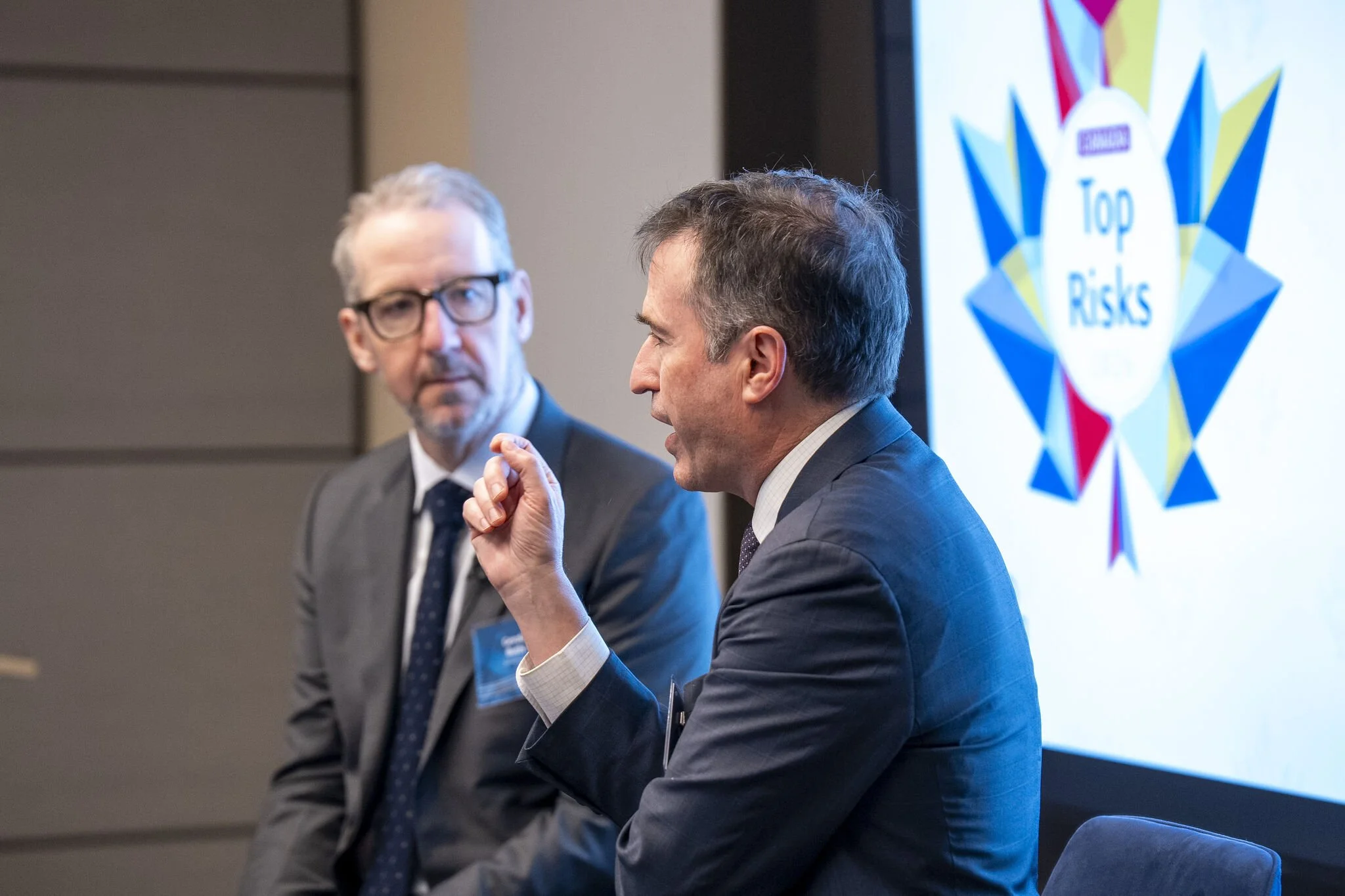
John Stackhouse pictured with Gerald Butts. / LINKEDIN PHOTO
One of the top risks facing Canada stems from how constitutional power-sharing among federal, provincial and Indigenous governments can slow economic decision-making, says Gerald Butts, vice‑chairman and senior advisor at the Eurasia Group.
“Ignoring constitutionally enshrined rights holders is a guarantee that we get nothing done,” Butts said on the latest episode of RBC’s Disruptors podcast with senior vice-president John Stackhouse.
Butts argued Canada must rely on “the old-fashion fine art of persuasion” to align regional interests with national economic goals. He emphasized that there is no “magic bullet” for managing the country’s constitutional complexities, and that success depends on engaging the provinces and Indigenous peoples. Even with a prime minister he calls “the best economic mind we’ve had in that chair,” Butts stressed that tangible progress depends on building consensus: speed and execution must go hand in hand with respect for the country’s design.
Beyond this, trade with the U.S. remained a central topic. Butts described the Canada–United States–Mexico Agreement as increasingly fragile, warning that uncertainty around its enforcement is already shaping business decisions.
“The best thing we can hope for coming out of this year is an annual continuation of the [CUSMA],” he said, adding that a collapse would disrupt more than $1 trillion in trade.
Still, Butts noted that Canada maintains comparatively low tariff exposure and remains the U.S.’s largest export market — leverage he said is often underestimated in Canadian political debates.
The podcast also explored Canada’s global positioning beyond the U.S. While China could try to “wedge” Canada against Washington, Butts said Beijing currently sees Canada as a “nice-to-have” rather than a necessary partner.
Fresh from the World Economic Forum in Davos, Stackhouse said global power dynamics are shifting faster than many Canadians realize, and the U.S. is no longer the stabilizing force it once was.
Stackhouse said this year’s Davos felt less consensus-driven than in the past, with a large U.S. delegation using the forum to promote a revived “America First” agenda. For countries like Canada, he said, that shift raises the stakes.
“If you’re a middle power anywhere, and that’s what Canada is, this new world certainly will be for the brave,” Stackhouse said.
Butts added: “The United States, for all of our lifetime, has been the world’s most important shock absorber of geopolitical risk and now it’s become probably the world’s most significant generator of geopolitical risk.”
Despite the uncertainty, Stackhouse said Canada attracted significant interest in Davos from investors in Europe, Asia and the Middle East, particularly in infrastructure, energy and artificial intelligence. He warned, however, that Canada’s slow pace of project approvals could limit its ability to capitalize on that interest.
“If there’s a window open, it’s not going to stay open much beyond this year,” he said.
Looking ahead, Butts and Stackhouse encouraged Canadian leaders to diversify trade and investment relationships; a “Third Way” strategy discussed since the 1970s, now more urgent as the U.S. share of global GDP declines.
“With risk comes opportunity,” Stackhouse said. “That’s how disruptors succeed.”