Budget Officer is optimistic on outlook but remains troubled by lack of clarity
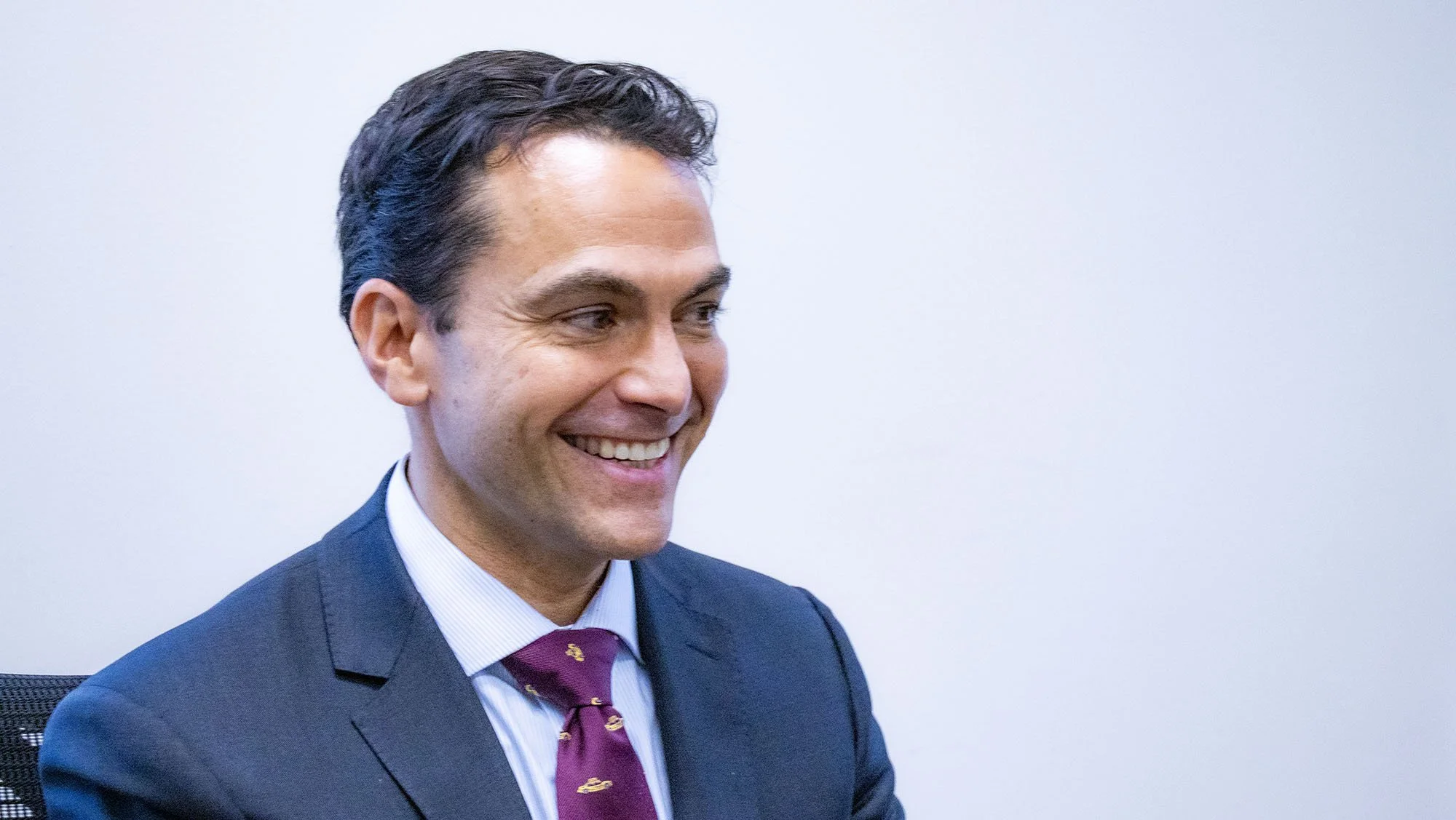
Interim Parliamentary Budget Officer Jason Jacques says the fiscal room parliamentarians and the public are familiar with is no longer available with the government’s change to its fiscal anchors. ‘That’s effectively gone at this point,’ he says. / MEANS & WAYS PHOTO
After an uncertain and volatile year, interim Parliamentary Budget Officer Jason Jacques sees an economy caught between the breakdown of decades-old trade rules and the slow, uneven emergence of a new global order — a transition that is already reshaping investment decisions, government finances and the country’s economic confidence.
Tariffs, trade friction and geopolitical instability are colliding with long-term structural change, Jacques said, leaving Canada in a period of uncertainty that feels both unavoidable and unresolved.
“It seems to be pretty clear from an economic perspective, from a trade perspective, we’re not going back to where we were before,” Jacques said in an interview with Means & Ways. “And at the same time, it’s unclear where we’re going.”
Against that backdrop, Jacques said the biggest challenge facing Canada as it heads into 2026 is the country’s response. He noted that while there’s a plan to increase spending on security and defence and to support the sectors affected by U.S. tariffs, the IMF has highlighted that “sector-specific subsidies, procurement mandates, or exemptions should be narrow, time-bound, and tied to clear market failures, with careful attention to fiscal risks.”
“Trying to decide what you're targeting and how long that's there, and what the success factors look like, at what point can the federal government step back – that's definitely the biggest challenge right now,” Jacques said.
Maybe it’s not so bad
Despite those uncertainties, he said recent data suggest the Canadian economy may be on firmer footing than previously thought. “We ended up having a really great surprise last week with the GDP numbers that were released by StatsCan,” highlighting substantial upward revisions to growth going back to 2022.
“The economy was actually in much better shape than anyone anticipated or anyone thought, going into the trade friction,” and more recent quarterly data were also “more positive than anticipated.”
Canada’s GDP per capita has declined since 2022 as population growth outpaces increases in economic output. Earlier estimates showed real GDP per capita at about $58,700 in the second quarter, roughly in line with 2017 levels and on a downward trend. Revised data now place real GDP per capita above $60,000, which remains below 2022 levels but is higher than before the pandemic and has been moving largely sideways.
A similar revision applies to productivity, measured as output per hour worked. Previous data indicated a marked slowdown in productivity growth in recent years. Updated figures revise productivity growth upward by 0.7 percentage points in each of the past three years.
He argued that much of the current turbulence reflects a transition rather than a permanent decline. “There’s going to be growth in some areas, potentially less growth or shrinkage in others,” he said, as firms and workers adjust to new conditions.
‘People are the economy’
Jacques emphasized that Canada’s underlying strengths remain intact. “It’s the same 42 million people who are well educated, who are willing to work hard, who are willing to move to find new jobs, who are willing to go out on their own and create their own businesses. People are the economy.”
Over time, he said, government-supported capital investment should help reorganize those people and resources more productively. “Once all that happens, we should be off to the races,” Jacques said.
Earlier this year, Jacques’ language to describe the federal government’s fiscal management as “unsustainable” and “shocking” drew significant attention. He said the reaction, however, helped sharpen parliamentary focus on underlying fiscal risks.
“From my perspective, the words themselves ended up becoming a distraction from the underlying technical factors,” he said.
Those technical factors included the Parliamentary Budget Officer’s first-ever medium-term forecast of the federal debt-to-GDP ratio, which showed the ratio rising over five years, even before accounting for roughly $100 billion a year in additional spending pressures.
The findings marked “an inflection point for parliamentarians,” including both newly elected MPs unfamiliar with the concept of debt-to-GDP and more seasoned lawmakers who initially assumed the outlook was routine, he said.
He told Bloomberg that he recalled speaking in committee meetings and worrying MPs weren't paying attention, which prompted him to use the stronger language.
Not your grandfather’s economic and fiscal outlook
“It was clear to me that they thought it was, oh, this is a run of the mill economic and fiscal outlook, and I was trying to explain to them, no, it's not. Actually, there are some really fundamental differences,” he said. “It is a really challenging fiscal situation overall. I think parliamentarians definitely get it now.”
Those concerns intensified with Budget 2025, which replaced the long-standing commitment to a declining federal debt-to-GDP ratio with two new fiscal anchors: balancing operating spending with revenues by 2028-29 and maintaining a declining deficit-to-GDP ratio.
From a purely mathematical standpoint, Jacques said those anchors do not guarantee fiscal sustainability. “You could balance your operating budget and you could have a decline in deficit to GDP ratio every single year,” he said. “We calculate the probability of that happening is about 7.5%, so it’s really low.”
Even if achieved, he warned, “you could still have an increasing debt to GDP ratio.” Debt-to-GDP, he said, is “really simple… the amount of debt you have versus your capacity to pay for it.”
For businesses and Canadians, that matters because a rising debt burden can eventually constrain government flexibility, raise borrowing costs and limit the capacity to respond to future shocks. Jacques noted that under current projections, the debt-to-GDP ratio is forecast to increase over the next five years and remain effectively flat over three decades — and that’s before accounting for major commitments such as higher defence spending.
Big changes, little debate
Jacques also raised concerns about transparency, arguing that major changes to fiscal management were made with little public debate. “The change happened really quickly, without a lot of discussion,” he said, noting that the IMF subsequently urged Canada to restore the debt-to-GDP anchor.
Additionally, there could be some concern with the government’s budget priority for making capital investments to boost productivity.
“Not all capital investment is created equal,” Jacques added, using the analogy of a home renovation versus expanding a house’s footprint. That distinction matters for Canadians because poorly targeted investments may not generate the growth needed to stabilize public finances over time.
On defence spending, Jacques said the lack of clarity is particularly troubling. “We have a mandate for transparency and fiscal transparency,” he said, adding that neither Parliament nor the public has been given clear information about how new defence commitments fit into the budget framework. “Parliamentarians deserve better.”
Jacques also pointed to housing, noting that current plans show a sharp decline in federal housing spending, even after accounting for new programs. While he acknowledged the government can change course in future budgets, he said his office is assessing “the government’s current plan,” which shows “a 56% cut in spending annually on federal spending on housing.”
Despite the challenges, he struck an optimistic note about the medium-term outlook.
“It's definitely going to be bumpy as part of the transition,” he said. But, “there is steady overall growth that should be building over time. So, that's a good reason to be hopeful.”
Five questions with Jason Jacques
M&W: What is the biggest challenge Canada faces as we head into 2026?
JJ: It’s Canada's response to the changing world order. … The PBO job seems easy by comparison to what they're going through in the Flaherty Building (headquarters of the federal finance department).
M&W: How would you describe the economy in one word?
JJ: In 2025, exciting.
M&W: I wasn't expecting exciting. Why?
JJ: From a geeky perspective, every time that we were looking at something, every time that something new came up, we had to ask the question, ‘Okay, how do we model that? Where have we seen it before? What does the research look like? Do we need to model? Does our existing model work? Is it calibrated in the right way that makes it interesting, and there are a lot of surprises? …Having been around here for a long time, and most recently, having spent 12 months responsible for the economic and fiscal outlook — the first one I was responsible for in fall 2024, it was, ‘Oh, here's the model, here's the updated data. This is what it comes out with.’ … And then all of a sudden, we're going to 2025 and it's, ‘Oh, we've never seen this before. So how are we going to approach this? And what's reasonable?’ Hopefully things are less exciting in 2026.
M&W: What is the one thing Canadians should be watching for in 2026?
JJ: The one thing I'm looking at on a daily basis is the labour market. … If you're between the ages of 15 and 64 the labour market has been surprisingly resilient outside of those trade-exposed sectors. … The one stat that I look at every single month is unemployment 15 to 24 and we're down to 406,000 but it's still 406,000 kids who want full-time work, can't get full-time work. … Outside of everything that people do around housing and other issues of affordability and other types of supports, it's got to start with the labour force.
M&W: When will the Bank of Canada cut interest rates again?
JJ: I think the bank has called it perfectly, primarily because that's what our forecast indicated — that this is it, and the next interest rate change we're looking at is probably an increase.
M&W: What is keeping you up at night?
JJ: Oh, it's the amount of change that's happening so quickly on the fiscal and financial management side by the Government of Canada. And the concern on my part, again, whether it's like a 634-page Budget Implementation Bill in C-15, or switching out the fiscal anchors without any meaningful discussion … the concern for myself is there's a lot of change happening around some of the basic elements of financial management, and Parliament isn't being given enough time to discuss them in a meaningful way. And the risk, the real risk, in the longer term. Even if you like the changes that are happening now, if there isn't a lot of scrutiny or a lot of meaningful discussion, you might not like the changes that somebody else in the future decides to make without a lot of discussion or a lot of debate.