Carney’s global Rolodex to spark investment summit
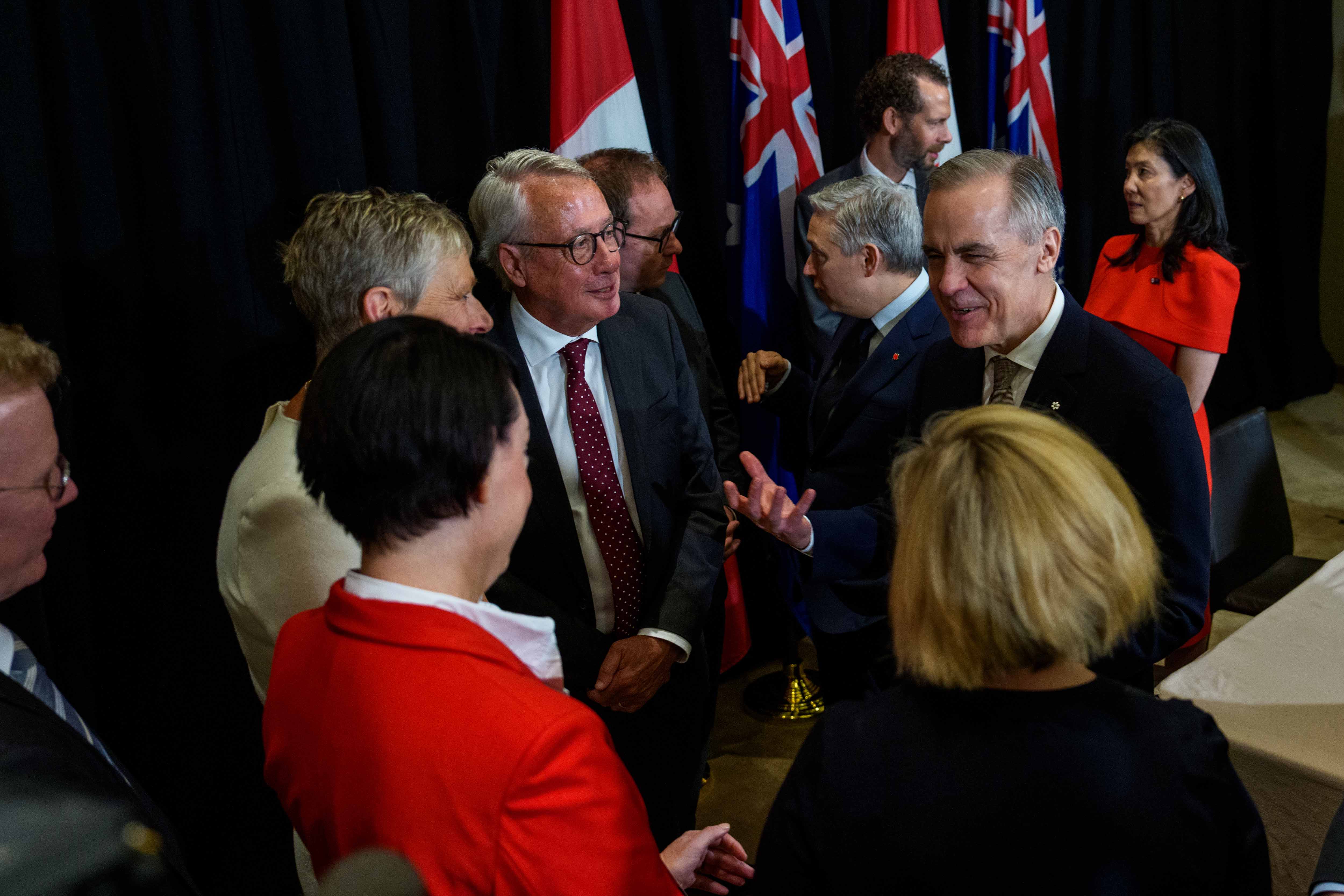
Prime Minister Mark Carney speaks with business leaders and officials during a recent trip to Australia. / PMO PHOTO BY LARS HAGBERG
Mark Carney, who once chided corporate Canada for sitting on piles of “dead money” that should be seeded back into the economy, is now turning to global CEOs for the business investment this country badly needs.
On Friday, the federal government announced a Canada Investment Summit that will bring investors, CEOs and business leaders to Toronto in September. According to the PMO, the government intends to tap into $1 trillion in investment over five years to advance nation-building projects.
Driven by Carney’s international activities and Canada’s reputation for stability, funding from abroad has been the one bright spot in Canada’s grim business investment picture.
Foreign direct investment into Canada totalled $96 billion last year, the highest since 2007, TD Bank reported. At the same time, Canadian direct investment abroad dropped to $79 billion, the lowest level in five years.
This came after what RBC calls an “unprecedented capital recession” — a decade of weak business investment, stalling productivity, and stagnating living standards. Between 2015 and 2024, more than $1 trillion of investment exited Canada — the largest capital exodus in Canadian history, RBC writes. For every dollar of inward Foreign Direct Investment, two dollars exited.
Domestically, the underperformance in business investment stretches back to the 2009 financial crisis. In 2012, Carney — then Bank of Canada governor — sparked a controversy when he challenged businesses over the $526 billion they were holding on their balance sheets, an amount that was 43 per cent more than at the end of the recession three years previously.
As prime minister, Carney doesn’t talk about it in the same phrasing, but trying to mobilize that kind of money has been a key part of his economic rebuilding strategy.
Energizing the business climate is an uphill battle
According to RBC, the non-financial corporate sector today has more than $1 trillion in cash on hand.
The federal government’s 2025 budget in November contained billions of dollars in investments and tax incentives intended to kickstart $500 billion in private sector investment over five years. The idea was to energize the business climate and galvanize construction of the infrastructure needed for ongoing economic growth.
But doing so is an uphill climb. Since 2015, the gap in investment per available worker between Canada and other OECD countries has been widening. By 2025, Canadian workers were expected to receive only 70 cents of new capital for every dollar received by their counterparts in the OECD as a whole and 55 cents for every dollar received by U.S. workers, according to the C.D. Howe Institute.
Responding to years of studies and business recommendations, the Carney government has taken steps to try to eliminate what many consider the main hindrances to domestic business investment. This includes Ottawa’s efforts to streamline overly lengthy and duplicative regulatory processes, free up resource development, overcome infrastructure blockages, improve worker training and reduce the internal trade barriers strangling the economy.
But this strategy has run head on into uncertainties from the generational turmoil caused by U.S. President Donald Trump’s year-old trade onslaught against Canada, and now, the U.S.-created conflict in the Middle East.
Even before the war in Iran, investment intentions were subdued, according to the Bank of Canada’s most recent Business Outlook Survey in late 2025. “Heightened uncertainty remains a major factor holding back investment plans,” and what investment does emerge is expected to be largely directed to routine maintenance, the BoC reported.
So it’s no surprise that the Liberal government, aware that lack of business investment is undermining productivity — and hence, Canadians’ living standards — is looking beyond our borders more than ever for the financial power crucial to re-inventing the post-NAFTA economy.