Bank of Canada opens door to lower interest-rate setting as U.S.-driven economic turmoil mounts
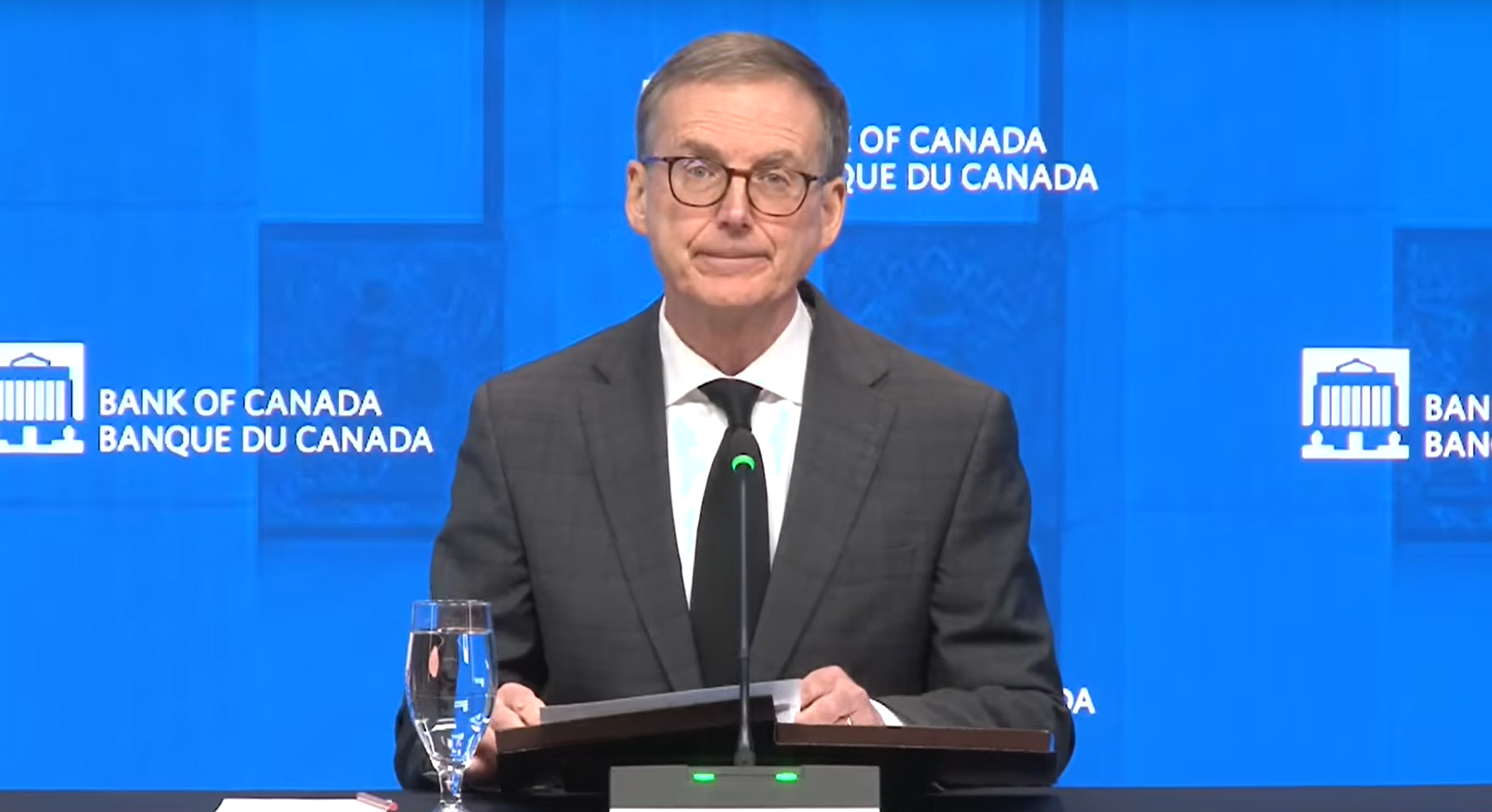
Bank of Canada Governor Tiff Macklem, pictured at a press conference on Jan. 28.
Investors, business owners and mortgage holders will have to rethink widely-held assumptions about the Bank of Canada’s interest-rate path after the central bank’s latest analysis of economic risks.
Governor Tiff Macklem has previously said the BoC can only do so much to offset the damage of a trade war and signalled an unwillingness to reduce its key overnight interest rate below 2.25 per cent. Markets concluded with unusual consensus in recent months that Macklem and his colleagues at the bank–who brought in a cumulative 100 basis points in cuts last year–would hold steady throughout 2026.
Although this week the bank declined to alter its policy rate, Macklem altered the rate-prediction equation by drawing more attention to the rise of economic risks boiling out of the United States.
One might have thought that the central banker’s somewhat softer tone about the possibility of more cuts was a way to keep the no-change-in-2026 conviction from becoming baked into thinking across the economy, a development that could have undesired effects on investor and business decisions.
But Macklem’s comments on Wednesday seemed to reveal a frank recognition that the chaos emanating from the Trump administration has made predictions about the Canadian economy much more difficult.
“There is unusual potential for a new shock, a new disruption. Geopolitical risks are elevated,” he told reporters in reference to January’s tumultuous events.
He alluded to President Donald Trump’s tariff threats, presumably the threat of 100 per cent tariffs on Canada if Ottawa tightens trade ties with China. And his talk of geopolitical upheaval was an obvious reference to Trump’s talk of invading Greenland, which also involved warnings about tariffs on any allied country that opposed the president’s expansionist thinking about Denmark’s arctic territory.
Those days are over
"It's pretty clear that the days of open, rules-based trade with the United States are over," Macklem told reporters.
Looking forward, the bank projected very modest economic growth of 1.1 per cent in 2026 and 1.5 per cent in 2027–and that’s IF tariffs and trade relations with the U.S. don’t get worse.
“Predicting how geopolitical events will unfold and how they will affect the global and Canadian economies is difficult,” the bank said in its quarterly Monetary Policy Report.
“If tensions escalate and events disrupt global supply chains and commodity markets, goods inflation could rise more than expected. Geopolitical events could also slow economic activity,” the MPR stated.
“For example, financial markets could demand higher risk premiums, which would raise borrowing costs and weaken confidence. This would slow the growth of gross domestic product (GDP) and reduce inflationary pressure.”
The other major source of uncertainty is the review of the Canada-U.S.-Mexico Agreement (CUSMA), the bank said. It characterized the negotiations as a downside risk.
Under the subhead “Canada’s economy could be on a lower path,” the MPR said: “Nearly all of Canada’s exports are compliant with CUSMA, and this has helped preserve the competitiveness of Canadian exports overall. An unfavourable outcome of the review would weaken the competitiveness of Canadian exports, lowering export volumes. Faced with weaker demand, exporters would reduce production, investment and hiring. This would spill over into the broader economy, weighing on sectors such as services and putting Canadian gross domestic product on a lower path.”
The BoC said Canadian businesses are adjusting to the tariff wall thrown up by Trump but it is an uncertain, timely exercise.
In a statement accompanying Wednesday’s rate decision, the bank said its current position is appropriate for today’s conditions. But Macklem signalled his willingness to step in with lower interest rates if need be. “Uncertainty is heightened and we are monitoring risks closely,” the bank said. “If the outlook changes, we are prepared to respond.”