Canada is a beacon of resilience in the global economic fog: Champagne
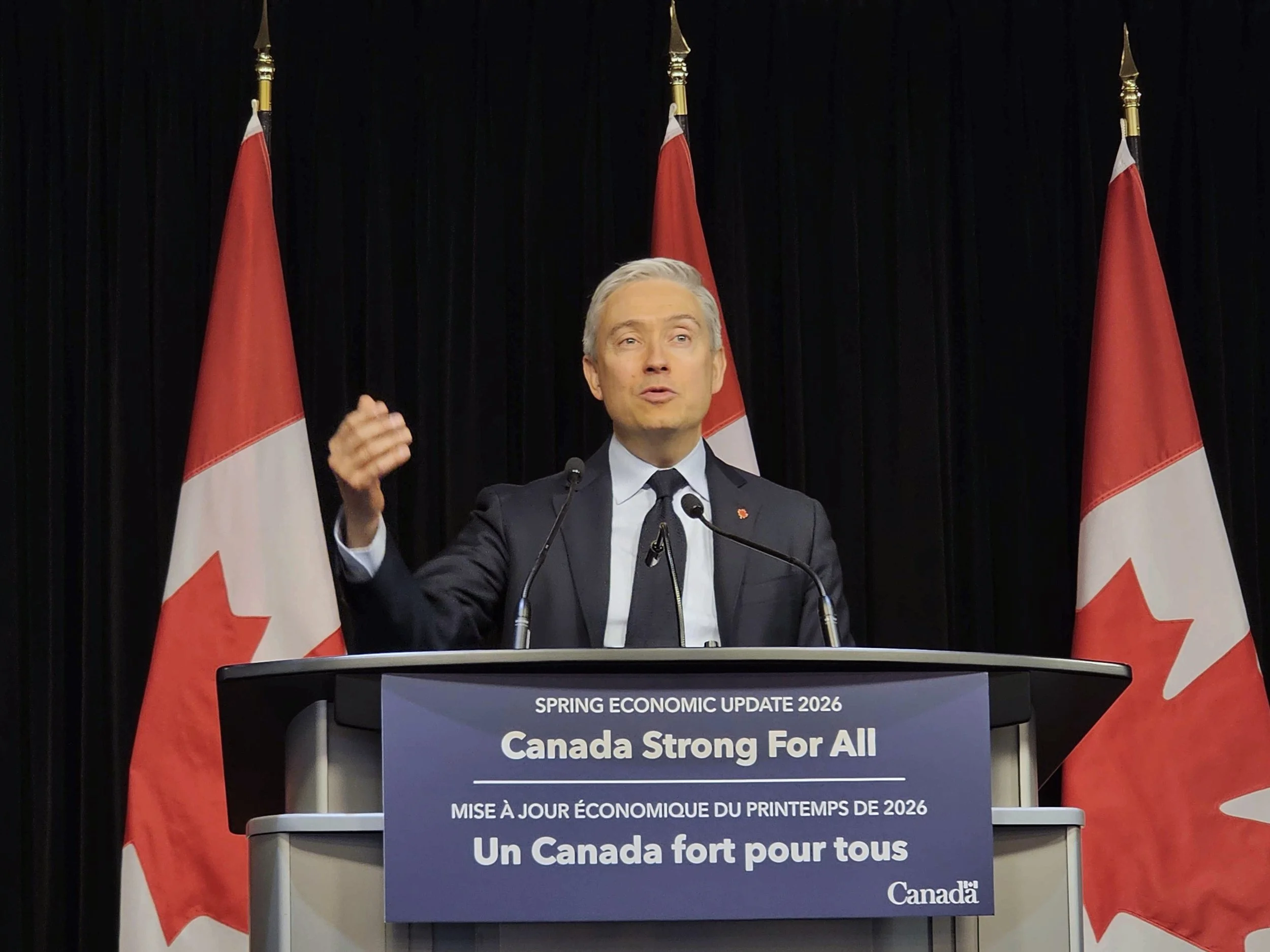
Finance Minister Francois-Philippe Champagne speaking to media about the Spring Economic Update. ‘Growth does not happen by accident. Growth happens because you have strong policy,’ he said. / MEANS & WAYS PHOTO
The government’s Spring Economic Update shows a significantly lower deficit than projected in the November budget, which the government says is good news, but the overall economy remains weak, say experts.
“One per cent real GDP growth, that's a weak economy. So that doesn't sound like strength to me,” Kevin Page, President and CEO of the Institute of Fiscal Studies and Democracy, told Means & Ways.
Finance Minister Francois-Philippe Champagne positioned the government as prudent financial managers restoring fiscal discipline in the Spring Economic Update tabled today.
The update noted that while the global economy is uncertain, “Canada is starting from a position of strength.”
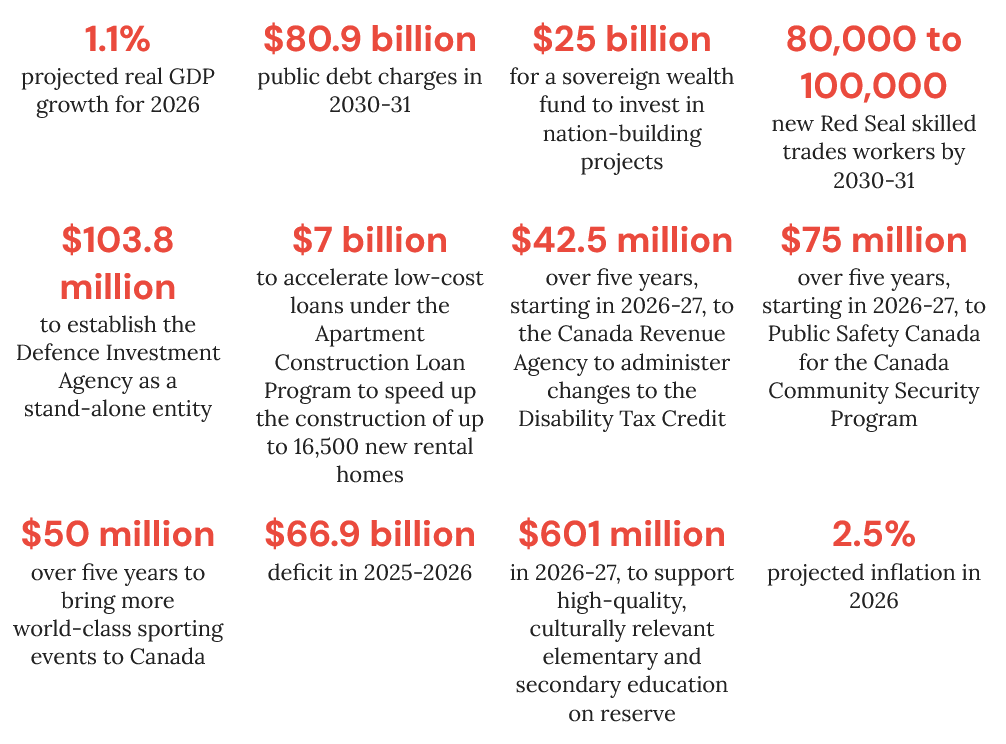
The economic update shows a $67 billion deficit, $11.5 billion lower than projected in Budget 2025. The government projects the deficit to continue decreasing by an average $10.7 billion per year from 2026-27 to 2029-30 before new measures. The update also includes $54.5 billion in new spending, which the government says is possible because of increased revenues and reduced expenses based partly on lapsed planned spending from Budget 2025.
Real GDP is expected to grow modestly at 1.1% this year and 1.9% in 2027, which is below the 2025 budget projection of 1.2% in the 2025 budget and 2% in later years. The government says it doesn’t expect growth to return to pre-tariff levels, “remaining about 1.6% lower by 2029 relative to the pre-tariff 2024 Fall Economic Statement.”
Building big, moving fast
Champagne said despite the trade uncertainty, Canada’s economy is resilient. “Canadians are resourceful people. So together we can chart a path forward through the fog of uncertainty because Canada has what the world wants and increasingly needs,” Champagne said in a speech after tabling the update.
“We have the right plan. We’re building big, we’re moving fast and the good news — we’re just getting started.”
Page said that while Canada has shown resilience compared to other countries, the deficit remains high and could widen — despite the government’s projections — because of a “major transparency hole” in the document. A big part of the government’s Build Canada plan includes reaching a 5% of GDP target for national defence as a NATO member. Page said, however, there was no line item or any more details on how the government intends to reach that goal. This is a concern because the economy remains weak and the government will have to increase revenue to pay for this commitment or cut expenditures significantly.
“It's the biggest fiscal moving part in the spending planning framework,” Page said. “What does the next five years look like? Where do we go from here? … We don't have the line, so how do we hold the government accountable to that commitment?”
Meanwhile, Page said, the government received more revenue because of higher inflation and chose to spend it rather than reduce the debt or deficit.
More spending, less investing
Page argued the government chose to spend windfall revenue rather than building reserves against global risks like CUSMA or Middle East instability. He noted that while support for households is positive, the government’s claim of "spending less and investing more" is misleading.
“They got a bit more fiscal room and they chose to spend rather than invest,” Page said, adding that the new funding failed to target capital formation.
Rebekah Young, Scotiabank Vice-President, Economic Policy, agreed. She told The Globe and Mail that the government’s spending is higher than expected. “I would have anticipated more conservatism in the fiscal developments given the uncertainties we have ahead,” she said. “But there’s a hefty spending package here.”
When asked how the government can describe itself as fiscal managers given the spending, Champagne told reporters: “The place where I think you need to give us credit is on the expense side. You know, we've identified $60 billion of reduced expenses. If you look over the last decade, if you look at direct program expenses, we were around 8% in terms of growth. We're going back to something closer to 2%. So on one end. Yes, you have GDP growth because the Canadian bond is resilient. Canadians are resilient.”
He added that half of the measures in the economic update went toward ensuring affordability for Canadians. “We have a strong economy, but we need to help people where they are now, which is affordability. We're building the country for long-term growth,” he said.
At a press conference during the media lockup, Champagne said while the economic outlook is good, the government understands not all will feel the optimism and it is working to address tariff-affected sectors—steel, aluminum, softwood lumber and autos. “We are going to continue our fight to make sure that we can restore trade and that we will always bring our voice loud and clear to our partners south of the border,” he said. “Much remains to be done. But we are building a Canada that is strong and fair.”
Investment in workers
The government outlined a “three-pillar approach” to addressing affordability issues: “Direct support for household budgets,” for example the National School Food Program and the Canada Groceries and Essentials Benefit; “Reducing key cost pressures where government can influence prices,” for example investing in child care, reducing gas taxes; and “Addressing the structural drivers of affordability,” for example attempting to increase housing supply and strengthening competition. All of these were previously announced, however, and not new.
In addition to the $25-billion sovereign wealth fund announced Monday, the update also makes a “flagship” investment in workers, Champagne said.
The government wants to train 80,000 to 100,000 Red Seal skilled trades workers by 2030 to align with needs in housing, infrastructure and defence. This will cost the government $2 billion over five years to increase the number of young Canadians entering the trades, and another $3.4 billion over five years to address apprenticeship challenges that prevent people from completing their training.
The sovereign wealth fund, called the Canada Strong Fund, will be established as a crown corporation that the government says revenue will grow over time “both from the returns that it generates, and through other assets that the government may allocate to it.”
The fund will be set up to deliver market-rate returns as it co-invests in infrastructure or nation-building projects with the private sector. Canadians will also be able to directly invest in the fund. A consultation will take place to design the fund and further details will be available in the coming months.
The update also noted the government’s recently-launched review of federal contracts to ensure the largest-value ones have opportunities to reduce costs. “The government will no longer settle for a good price; Canadians deserve the best price,” the update says. “Pricing in contracts will be supported by best practices and global benchmarking. Opportunities for a Team Canada approach to procurement, combining the buying power of federal, provincial, and territorial governments, will be leveraged where possible.”
Look out for targeted horizontal reviews
The government also says now that the expenditure review is done, targeted horizontal reviews will be reported in Budget 2026. They will “become a permanent and predictable approach to strengthening expenditure management,” the update says.
Additionally, the government says it will launch a Small and Medium Business Procurement Program later this spring “to make it easier for Canadian firms to compete and win in federal procurements, by modernizing digital tools and reducing barriers.”
Other highlights in the SEU include:
An outline of six pillars of an AI strategy, though there was no mention of when the strategy would be available.
Making the Employee Ownership Trust tax exemption permanent, which the government says “will help more workers share in the success of the businesses they help build.”
$755 million to expand access to sport “creating opportunities for Canadians to build meaningful relationships within their communities, making full use of existing and new infrastructure, and to support Canada’s world-class athletes.”
Streamlining the application process for the Disability Tax Credit
Establishing the Financial Crimes Agency
Addressing supply chain challenges by “examining options … including improving how trade corridors are planned and governed, accelerating the delivery of trade-enabling infrastructure, reducing regulatory burden on businesses, and modernizing trade processes.”
The government will soon release a Nuclear Energy Strategy.
Establishing the Defence Investment Agency as a standalone entity and introducing enabling legislation to establish the DIA as a stand-alone entity and legislative amendments to the Defence Production Act to provide the DIA with expanded authorities.
Launching a Whole-of-Government Competition Plan to strengthen productivity and affordability by ensuring that competition is prioritized throughout the federal government’s policies.
A consultation on whether the Canadian Journalism Labour Tax Credit will be extended
“Growth does not happen by accident. Growth happens because you have strong policy,” Champagne said, referring to the IMF stating that the countries that invest in housing, infrastructure and innovation will see growth, which is what he said the government did. “What we see is that the economy is stronger.”
In a statement, the Business Council of Canada said the update reinforces the government’s ambitions outlined in Budget 2025 and is aimed to help the federal government deliver on its plans. “The Business Council of Canada (BCC) applauds the government’s plan to create new pathways for young Canadians to get into the trades, representing a new investment of $6 billion over five years. Canada will need hundreds of thousands of additional skilled trades workers to achieve the government’s ambitious new agenda,” Goldy Hyder, President and CEO said. “The newly announced sovereign wealth fund also gives the federal government an added tool to help foster new investment in key sectors, which is welcome. Today, governments need more tools, not fewer. The BCC supports using fiscal policy to boost investment and productive capacity and welcomes the less-than-projected size of the deficit. At a time of global unpredictability, Canada can offer investors much needed certainty by approving projects, deploying capital, reducing the regulatory burden, and making measurable gains in competitiveness.”