Canada continues to woo EU with AI deals, but concerns about transparency and rural inclusion arise
MONTREAL, QUE. — Canada continued to look away from the U.S. with a new series of digital and artificial intelligence partnerships with European allies, announced at the G7 Industry, Digital and Technology Ministers’ meeting this week in Montreal. The government says they could accelerate innovation and economic growth, but experts warn that transparency, privacy protections and rural inclusion will make or break the effort.
While the federal government touted the initiatives as engines of future productivity, Joni Brennan, Digital ID & Authentication Council of Canada (DIACC) president, said implementation must be grounded in openness and privacy-first design.
“We'd love to see more transparency on what's in the MOU. What's the tone, what's the intent?” she told Means & Ways in an interview. DIACC, a public–private coalition founded by governments, banks and industry partners, has been advocating for secure digital identity tools since 2012.
Digital credentials must be collaborative, privacy-protective and voluntary, she said. “There needs to be strong public engagement on these tools and fostering and building public trust must continue. There must always continue to be alternative channels, traditional channels, for those who don't wish to or aren't able to adopt technology to be able to continue to do business in the way that they do today.”
At the G7 ministerial summit’s closing press conference, AI Minister Evan Solomon said the package of agreements marked a major step forward for Canada’s digital future. “We accomplished a lot. This was about growth. This was about making sure that we have productivity. This was about harnessing new technologies in the service of citizens, so technology serves them.”
Canada finalized a slate of international agreements, including the Canada–Germany Digital Alliance; the Canada–EU partnership on AI; a Canada–EU agreement on digital credentials and trust services; and a Canada–U.K. agreement on digital government.
Alongside the announcements, the G7 released a new SME AI Toolkit, described as “concrete resources to help businesses adopt AI, drive competitiveness and scale digital tools.” Canada also led development of the SME AI Adoption Blueprint, which Solomon said is designed to give smaller firms a technological lift.

AI Minister Evan Solomon met with Karsten Wildberger, Germany’s Minister for Digital Transformation and Government Modernisation, while participating in the G7 Industry, Digital and Technology Ministers’ Meeting in Montréal. / MEANS & WAYS PHOTO
'As G7 partners, Canada and Germany stand together in innovation and prosperity. Through the Canada–Germany Digital Alliance, we are deepening our collaboration on artificial intelligence, research exchanges and digital infrastructure. The partnerships announced today reflect our shared commitment to building a modern, tech-enabled economy that will enhance productivity across our countries,’ Solomon said.
‘Big step’ forward in transatlantic partnership
Henna Virkkunen, Executive Vice-President of the European Commission for Tech Sovereignty, Security and Democracy co-chaired the EU-Canada Digital Partnership Council meeting and said it was a “significant step” in strengthening cooperation and building both regions’ economies.
“In Europe, we launched a 1 billion webline AI strategy to really accelerate real-world deployment, and we will now exchange best practices with Canada to ensure that AI delivers productivity, growth and public value,” she said at the press conference.
As Canada deepens its AI partnerships with the EU, U.K. and Germany, Gordon More, Executive Director of the Southeast Tech Hub in Estevan, Sask., says the move could help protect Canadian data, strengthen small businesses and prepare the country for an AI-powered energy transition.
The agreement with the EU is about “recognizing that we are in a trade war,” he told Means & Ways. “It's recognizing the truth of the 51st state [comments], and what that means, and saying, ‘Okay, we can't do this alone. Who can we do this with? Whose data can we work with together equally? Whose AI algorithms can we trust and work with?”
He added that partnering with the EU and U.K. makes sense, because they have the same standards and privacy. “I would even go so far as to say the EU's got better standards and privacy around data protection.”
More said he was encouraged that the G7 discussions highlighted governance, shared values and small-business adoption. Digital skills training and SME-focused support is essential because the speed of AI disruption is accelerating.
Brennan said AI will profoundly reshape digital trust systems — for better and for worse. “AI is already breaking security features,” she warned, pointing to voice-spoofing that undermines existing verification tools. But AI can also strengthen cybersecurity by detecting anomalies and validating data.
She noted that studies have shown capabilities around digital identity, trust, credentials, wallets and AI has the opportunity to unlock 3% to 6% of GDP in national economies. “That’s a massive, massive opportunity,” she said. Realizing that potential requires sustained coordination across governments, sectors and communities. “It's not potential that comes easily, but we need to get on with it.”
Feds still ‘overlooking’ importance of rural Canada
Asked how the agreements could impact Estevan and southeastern Saskatchewan, More said the federal government continues to overlook rural opportunities. “Canada still hasn't addressed the broken policy that negates rural innovation and rural communities,” he said. “When we look at where the power is already coming from in Canada and where the power for AI will be coming from, it's almost all exclusively in rural communities.”
Transportation, agriculture, mining and critical minerals—industries central to AI adoption—depend on rural regions, he said. “I just would love to remind the federal government: look at these agreements that you are making, look at the announcement you made in the budget, and remember that almost all of this is rural centric, not urban centric.”
Yet government spending remains focused on major cities. More argued the new agreements could help government leaders finally address those gaps. “This is an opportunity again to fix the broken policy so that nationally, the country can become more innovative, more disruptive in a positive way, and we have better sovereignty and more wealth within our country.”
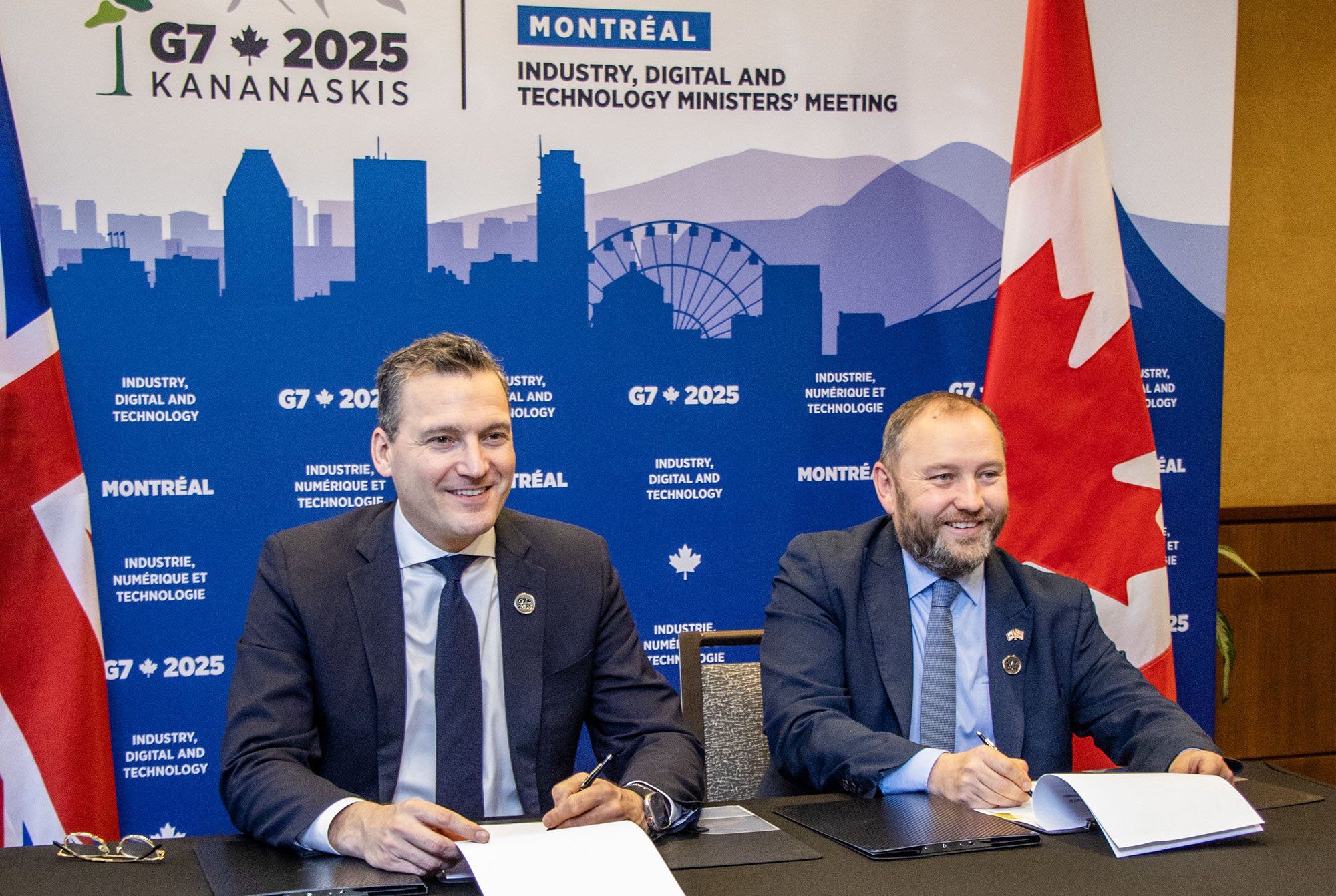
AI Minister Evan Solomon met with Ian Murray, the Minister of State for Digital Government and Data for the United Kingdom on the margins of the G7 Industry, Digital and Technology Ministers’ Meeting in Montreal. / MEANS & WAYS PHOTO
‘The UK and Canada share a close partnership—particularly when it comes to science, innovation and technology. My visit this week is all about ensuring those bonds deliver for hard-working people—from Calgary to Cowdenbeath and Winnipeg to Winchester. As we continue to work shoulder to shoulder, there's no limit to the benefits and opportunities we can unlock as we harness the potential of emerging technologies,’ Murray said.