Unclogging Canada’s military procurement arteries
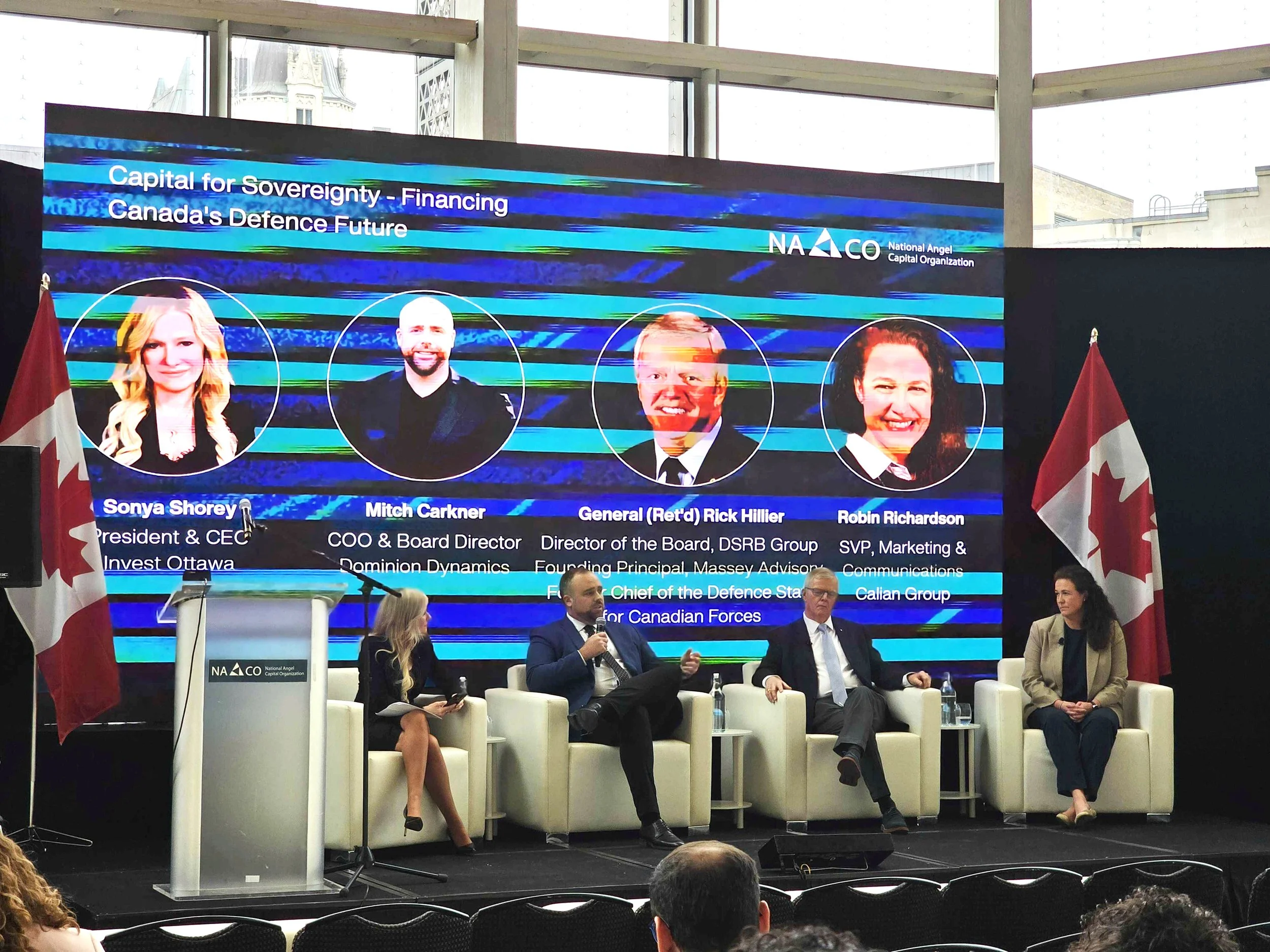
Sonya Shorey, President & CEO of Invest Ottawa moderated a panel discussion on capital for sovereignty with Mitch Carkner, COO & Board Director, Dominion Dynamics; General (Ret'd) Rick Hillier, Director of the Board, DSRB Group and former Chief of the Defence Staff for the Canadian Forces; and Robin Richardson, SVP, Marketing & Communications, Calian Group at the NACO Summit in Ottawa May 6. / MEANS & WAYS PHOTO
Canada's defence innovation ecosystem is at a historic inflection point, but procurement timelines that stretch seven to 15 years risk negating every dollar invested and every company built, says retired General Rick Hillier.
Hillier, a former Chief of the Defence Staff who now sits on the board of the Defence Security and Resilience Bank, said a structural bottleneck is holding Canada back.
"The greatest security threat as we go forward is innovation, production and procurement — and procurement is the key part of that," he said. "If our procurement is going to persist in being a seven- to 15-year project, we're not going to survive."
One solution, he said, could be giving the Minister of National Defence direct spending power, and handing chief commanders of the army, navy and air force an equal amount to spend on the equipment they need right away. "Trust them," he said. "We trust them to look after our sons and daughters in war fighting. Surely within the basic framework of accountability, we can trust them with that."
He also proposed carving defence procurement into nimble, delegated envelopes: "$100 million for the army, $100 million for the navy, $100 million for the air force — divided into $10 million packages — and say, it's yours, Commander. Buy it and use it and take that risk." He pointed to U.S. Special Forces as a model: buy equipment, test it for a year, discard it or order the next generation. "What you do is reduce the risk of not having the best capability, and you increase the chance of turning innovation into commercialization."
Hillier was speaking on a panel this week at the NACO Summit in Ottawa, along with Mitch Carkner, COO & Board Director, Dominion Dynamics and Robin Richardson, SVP, Marketing & Communications, Calian Group. The panel was moderated by Sonya Shorey, President & CEO, Invest Ottawa.
A defence startup that ‘kicked in the door’
Early-stage angel investors can make or break a defence startup, said Carkner, who described a deliberate and methodical path to raising over $30 million, one that began not in a boardroom but on the frozen tundra. "We kind of kicked in the door, went and found a Canadian Forces unit — the Canadian Rangers — that didn't care about options, they didn't care about waiting and procurement. They said, 'We want to use your thing. Come use your thing.'"
Carkner spent a winter in the Arctic with the Rangers deploying Dominion Dynamics’ capabilities in the field, a move that gave him both proof of concept and credibility. But before institutional investors came into the picture, angels were the critical first movers.
"We took first cheques from about 12 angels so that everyone is going to know who they are, and leverage their network and their credibility," Carkner said. That credibility, combined with early field execution, gave Dominion Dynamics the foundation to approach larger funds. The company raised $4 million pre-seed, then $21 million from Georgian and a BDC pension fund before raising additional capital to reach its current total.
Carkner said the sequencing mattered as much as the capital itself and that trust and speed “are everything” at the seed stage.
Hillier underscored why institutional investors can't play that first-mover role on their own. "You have to have an insane ability to attract institutions into their capital. They're not looking for private claims. They're looking for power and return. And you need to be able to articulate this year, next year, and ten years from now how you are going to do this."
Richardson, who leads Calian's venture strategy, described a different but complementary approach to the capital gap: using Calian's existing customer relationships and systems integration expertise to de-risk investment in early-stage defence companies.
Taking the risk out of investing
"What we want to do with Calian Ventures is invite autonomous, command and control and space solution companies to come to us with their products and ideas, and we will work with them to take them through that last mile — that testing, that validating, integrating the systems that Calian is already using," Richardson said. "We're taking the risk out of investing."
The model is designed to compress the most expensive and uncertain part of defence commercialization — the journey from working prototype to customer-ready product — by embedding startups inside Calian's existing contracts and relationships with the Canadian Armed Forces and NATO allies.
"We're looking at contracts that we currently have, and where we can bring that capability along into that ecosystem for the army or the Air Force," Richardson said.
She echoed Hillier and Carkner on procurement, citing a phrase she attributed to Chris Holmes: "Capital calls confidence, and confidence is contracts. We've got to see those contracts. We need to see them faster."
All three panellists agreed that momentum is building but that it remains fragile without sustained government signals.
Carkner called for "a consistent signal for the next 10 years" and projected that with the right commitment, Canada could add 20,000 jobs in aerospace and generate substantial sovereign IP for export to NATO allies.
Hillier said there is a direct line between procurement reform and national survival. He pointed to Ukraine's ability to reconstitute an entirely new generation of unmanned aerial vehicle (UAV) capability in three months — while Canada awaits its first long-endurance drone delivery in 2032 or 2033 at the earliest.
"Procurement is the greatest potential disruptor," he said. "Velocity is going to be decisive. We can do this."