
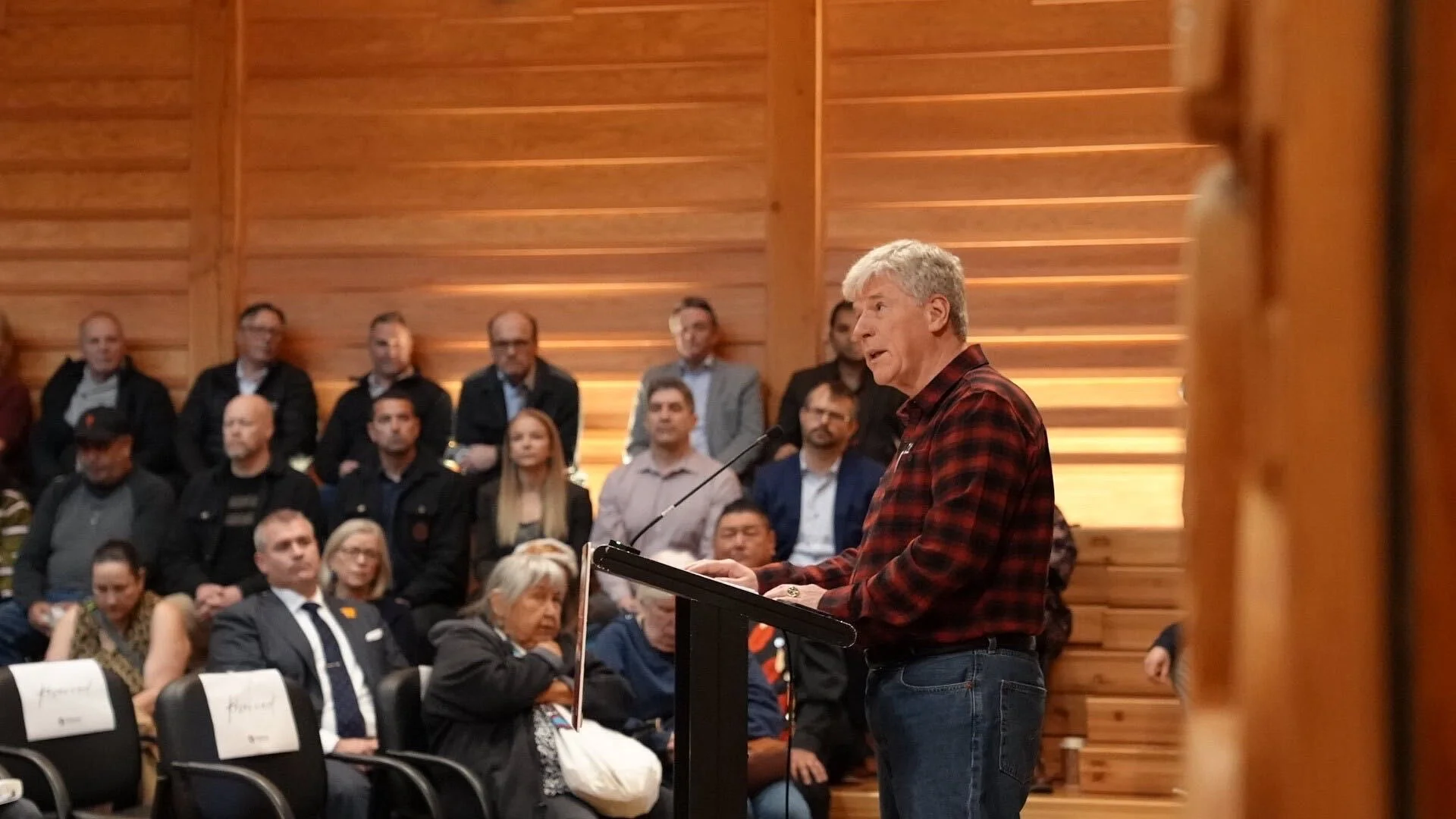
‘Between unjustified U.S. tariffs and duties, declining global demand for traditional products like newsprint, and increasingly severe wildfires, business as usual is not an option. That’s why we are launching Canada’s first-ever Forest Sector Strategy, backed by $6.5 billion in new funding over six years – the largest federal investment in the industry’s history,’ Natural Resources Minister Tim Hodgson wrote on social media. / TWITTER PHOTO
Natural Resources Minister Tim Hodgson unveiled a Forest Sector Strategy, committing $6.5 billion in new funding over six years to modernize the industry, secure wood fibre supplies, diversify markets and support workers and communities. The strategy, representing the largest federal investment in the industry’s history, aims to position Canada as the world’s leading supplier of traditional and advanced forest products by 2050.
“Canada is in a period of significant geopolitical and economic change. Global competition is escalating. Supply chains are shifting, and unjust tariffs and duties are impacting our businesses and workers. And I know that's happening right here in this town, so, ladies and gentlemen, business as usual is not an option for your federal government. Our forest sector is no exception to this,” Hodgson said at a press conference.
Speaking in Powell River, B.C., Hodgson emphasized the economic importance of Canada’s forest sector, which supports nearly 200,000 jobs and 300 communities and contributes nearly $30 billion annually to the national economy. Despite Canada’s position as the world’s leading net trader of forest products, the industry faces mounting challenges from tariffs, trade uncertainty, climate change, intensifying global competition and declining demand for traditional products. Hodgson noted that since 2004, the sector’s share of Canada’s GDP has fallen from approximately 3% to 1%, while employment has declined by more than 40%. Canadian softwood lumber production also fell by approximately 30% between 2017 and 2024, with the decline particularly pronounced in British Columbia.
“What does all of this tell us? It tells us that the status quo is not an option. We need to invest. We need to innovate, and we need to compete because a stronger forest sector means a stronger Canadian economy and, most importantly, it means a stronger Powell River. The question is not whether Canada's forest sector has a future. The question is whether we're going to do away with old-fashioned band-aid solutions and instead forge a bold path forward, and invest in a competitive, collaborative future,” Hodgson said.
The strategy is structured around four pillars: industrial transformation, competitive fibre supply, domestic and international market diversification, and support for workers and communities.
The federal government will allocate $2 billion through a Modernization Program to upgrade facilities, improve productivity and support research and innovation. A new $4-billion Forest Sector Accelerator will finance large-scale industrial projects and facility transformations, targeting higher-value products such as engineered wood, biofuels, biochemicals and bioenergy.
A $500-million Fibre Security Fund will support predictable, cost-competitive access to wood fibre through improved forest management, digitalization and partnerships with provinces, territories and Indigenous Peoples. The government also plans to streamline permitting and clarify regulatory requirements under federal environmental legislation.
To strengthen domestic demand, Ottawa will leverage federal housing, infrastructure and procurement investments to expand the use of Canadian wood, including mass timber and prefabricated building systems. Internationally, the government will support export diversification, attract foreign investment and improve transportation infrastructure, contributing to Canada’s broader objective of doubling non-U.S. trade by 2035.
The strategy also includes employment assistance, retraining, apprenticeships and Indigenous-led workforce development. Regional development agencies will direct up to $300 million toward forest sector business stabilization and competitiveness, alongside up to $100 million for economic diversification in affected communities.
Natural Resources Canada will coordinate implementation through a ministerial committee responsible for accountability, policy alignment and annual progress reports.
The Forest Products Association of Canada welcomed the strategy. President and CEO Derek Nighbor said there is an opportunity to build on the sector's strengths.
“The Strategy and Budget 2026 commitments are important steps forward. There is a lot of work ahead to translate them into stronger operating conditions, investment, and jobs,” Nighbor said in a press release. “We look forward to rolling up our sleeves with governments and partners across the country to deliver lasting benefits for Canada’s forest sector and the hundreds of rural and northern communities that depend on it.”
FPAC noted that "Turning that opportunity into results will require sustained collaboration across governments, industry, local communities, and the nearly 200,000 forest sector employees who are the backbone of our industry. For FPAC, the next phase of this work is about ensuring investment support reaches businesses in a timely and practical way, while addressing the barriers that affect their ability to operate, modernize, and grow. Canadians need to see urgency to put these commitments in place and ensure the regulatory environment we operate in is aligned with our objectives: more Canadian jobs, stronger supply chains, and new opportunities for forestry communities from coast to coast."
During remarks at the press conference, Nighbor emphasized the need for greater coordination across federal departments and stronger collaboration with provincial governments and local communities to protect and grow forestry jobs, accelerate affordable housing construction, streamline building codes and innovative wood product approvals, and mitigate wildfire risks. Looking ahead, predictable and durable regulatory frameworks that recognize locally developed forest management plans, ecosystem values and cultural priorities will be critical to attracting investment in forest operations, new technologies, manufacturing capabilities and workforce development while strengthening Canada’s international competitiveness, he said.
"Sadly, in this country, we make some really, really great wood products that we can't sell here because the approval system. We can sell them in the U.S., but we can't sell them in Canada. So those are the things that we really need to fix, and the strategy provides that blueprint," he said. "Predictable and durable rules between the feds and the provinces will encourage greater investment in our sector, in our woodlands operations, new technologies and new product lines at our mills, and most importantly, more investment in our people and the communities they call home."
Minister Hodgson underscored the importance of Indigenous leadership in Canada’s forest sector, highlighting the Indigenous Loan Guarantee Program’s support for the Tla’amin Nation’s acquisition of full ownership of Western Forest Products’ Stillwater Forest Operation in British Columbia. The acquisition will create long-term economic opportunities and stable revenues for the Nation while advancing Indigenous participation in the industry, a key priority of Canada’s Forest Sector Strategy, the government said in a press release.
“Coming out to launch this strategy in a forestry-reliant community like Tla’amin shows Canada’s seriousness about this industry and the value it places on it. This plan strengthens our belief that forestry has a strong future here. Our worldview and long-term vision, aided by the tools in this strategy, will build a forest sector that lasts for generations. Most of all, it will keep our greatest resource, our children and grandchildren, close to home with good jobs,” said John Hackett, Hegus (Chief), Tla’amin Nation.
When asked about clarifications around implementing the Species at Risk Act, Hodgson said stakeholders need the ability to reach decisions faster and whether the act applies to a project is an important factor.
“One of the things we need to get to is decisions on whether we can harvest or not harvest in a much quicker fashion,” he said. “We're not prejudging what the decisions are. We're saying collectively, as provincial governments, as Indigenous owners, as the federal government, we need to do that in a more efficient manner. The way I think about it is, we can't cut corners. We need to raise the competence of our decision makers. We need to make the decisions more effectively, more quickly, so that we can spend the time doing things that are productive. And where it's not appropriate to harvest, we don't harvest. That's what it means.”


