New council to advise Solomon, Miller on protecting Canada’s creative industries in the face of AI
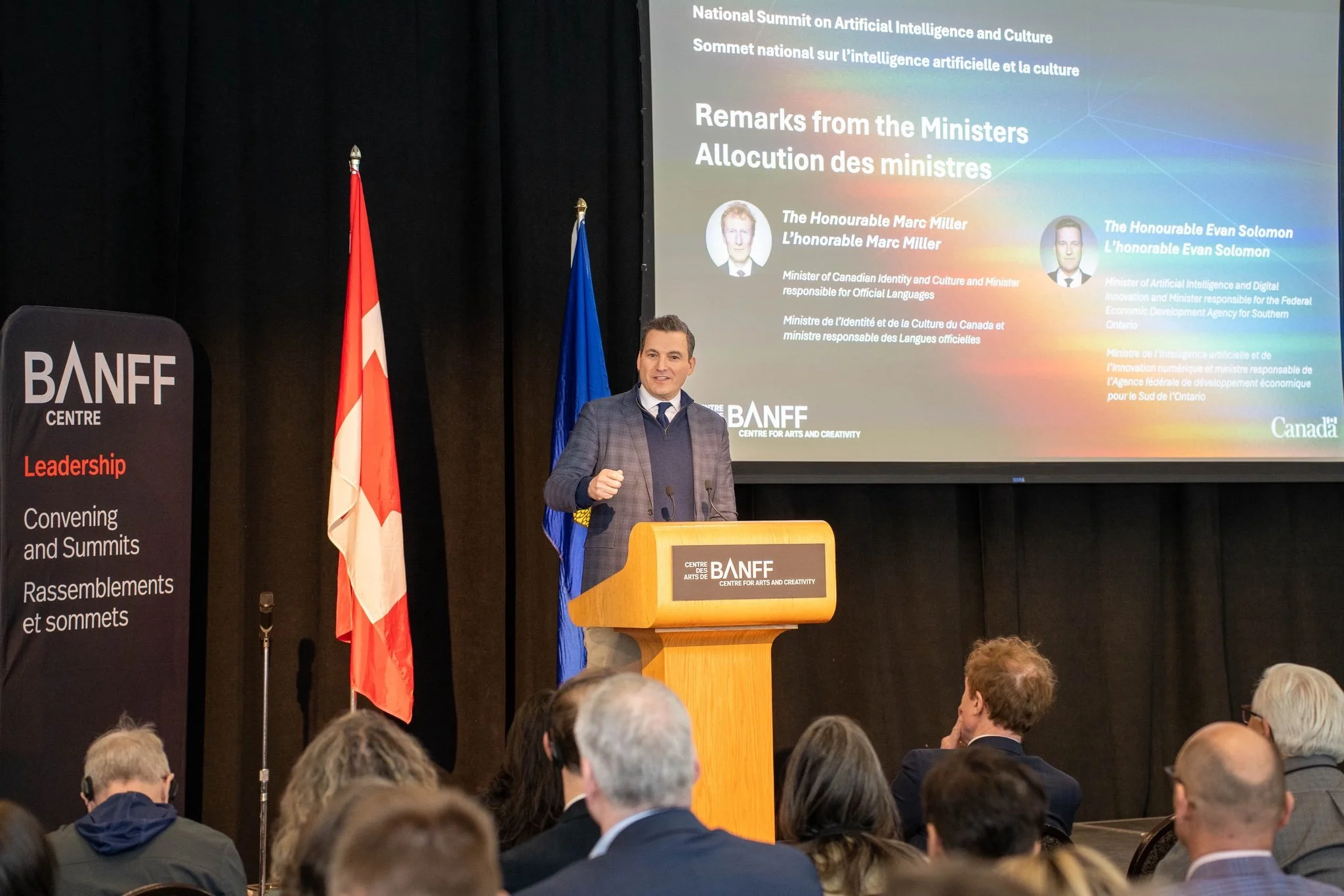
‘I joined leaders from across the arts and technology sectors at the National Summit on Artificial Intelligence and Culture, hosted by the Banff Centre for Arts and Creativity, in Alberta. Our government is committed to ensuring Canadian creators can take full advantage of these emerging opportunities while safeguarding the originality and strength of Canada’s creative sector,’ AI Minister Evan Solomon wrote on social media. / TWITTER PHOTO
The government announced a new advisory council to help protect Canada’s creative industries from rapid advancements in AI.
“We want a permanent way that, one, our ministries work together; two, that we codify the kind of stories and information that are here; and three, that we have a way that we can deal with ongoing issues,” Artificial Intelligence and Digital Innovation Minister Evan Solomon said.
The Advisory Council on AI and Culture — a joint venture between Solomon and Minister of Canadian Identity and Culture Marc Miller — will have 12 rotating members across creative and technology fields. No appointments were announced, following a three-day conference in Banff, Alta., which gathered more than 300 leaders from the cultural sector, government, technology and academia to discuss the challenges around AI.
The National Summit on Artificial Intelligence and Culture, held at the Banff Centre for Arts and Creativity, provided an opportunity to bring a national focus to what looms as an existential threat to arts and culture providers.
Among several topics, panellist Margaret McGuffin, CEO of Music Publishers Canada, said copyright issues are top of mind for the creative industries.
“AI in the arts is all that I'm talking about these days, specifically around music. The tech companies who are developing AI often forget to talk to the creators, the songwriters, the people who own the songs. And what we're looking for is a future where we could embrace their AI, but have us into the conversation much earlier,” she told CBC News.
“We want to talk about transparency. Build your AI so you know what you're using in your datasets. That's ethical, that's responsible, and that's going to make sure that songwriters are paid.”
McGuffin noted concern among artists around the ways in which AI could upend or harm their practice.
“You're really busy as a creative entrepreneur putting your career together and then this hits [generative AI], and it just seems like one more thing that's out of your control,” she said. “I'm much more positive. I see the first deals coming in, and I think we need to incentivize AI companies to pay songwriters.”
Speaking to the media, Miller said, “The current copyright law does and should protect those that have created material, and people need to be compensated properly.”
Shaw Rocket Fund President and CEO Agnes Augustin, who also attended the summit, said this is an “urgent” moment to ensure that Canada’s AI strategy include children.
“Generation Beta is being born this year and will be the first generation to grow up fully immersed in AI. This means we must invest in media literacy about AI, including privacy rights and copyright; ensure transparency in how content is created and shared so trust is intentionally built and support kids as future creators and entrepreneurs,” she wrote on LinkedIn. “From an industry perspective, this moment is equally urgent.”
She noted, however, that tools alone are not enough. “To remain competitive and to ensure Canadian and Indigenous kids see themselves authentically reflected in content they consume, we need a more holistic approach to funding that goes beyond content creation and also includes 1) training and skills development, 2) research and innovation investment and 3) export and discoverability strategies,” she wrote. “AI is already shaping the stories our kids grow up with and the stories they will one day tell. This is not just a technology discussion. It is a cultural, economic, and national priority. Let’s ensure kids are not an afterthought, but a fundamental part of what comes next.”