Look for mortgages to get more expensive soon
Canadian government bond yields jumped sharply this week, following a trend in the U.S. and globally, potentially leading to higher fixed mortgage rates in the near future, according to NBC economists Daren King and Kyle Dahms.
The yield on five-year Canadian government bonds rose to 3.65%, the highest since May 2024. However, Canadian mortgage rates have not increased as quickly. Since February, the five-year Canadian government bond rate has risen by about 0.92 percentage points, while the typical five-year insured mortgage rate has increased by only about 0.40 percentage points, King and Dahms wrote in a Sept. 10 note.
The spread between the two rates is the narrowest since late 2023, meaning banks and other lenders are currently making less money on each mortgage than they normally would. If borrowing costs continue to rise, lenders will likely need to increase mortgage rates to make up the difference.
“Such a narrow spread puts pressure on lenders’ margins and is likely unsustainable in the long run,” the economists wrote. “Mortgage rates are therefore likely to rise in the coming weeks, in a context where property prices have stabilized after several quarters of decline.”
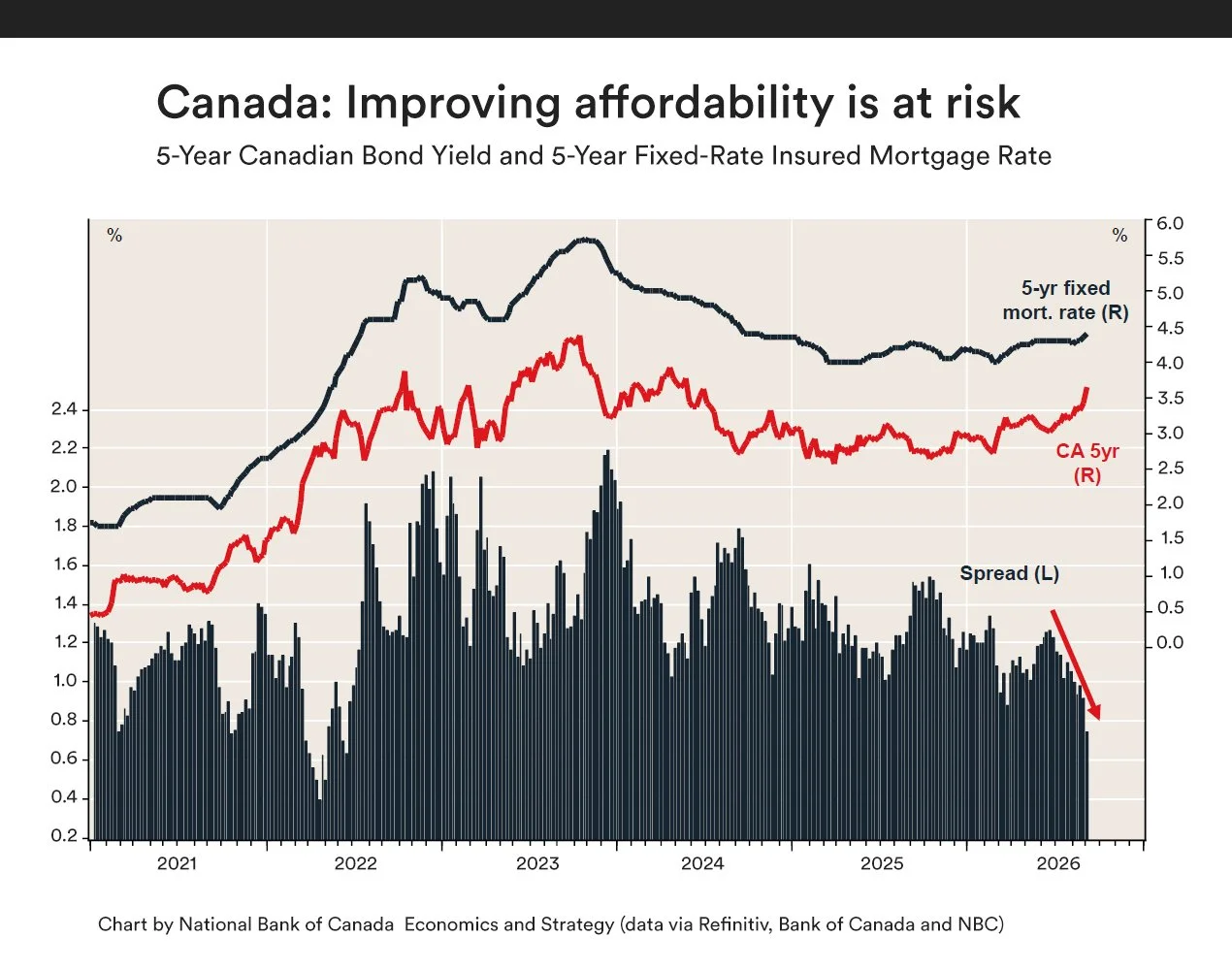
National Bank expects its affordability index — which measures mortgage payments as a percentage of income — to rise by 1.1 percentage points in the fourth quarter, marking the first decline in affordability in about three years.
Meanwhile, U.S. rates “surged across the entire yield curve,” on Thursday, with the U.S. 5-year yield hitting 4.76%, a near-three-year high.
“Two factors are at play,” wrote King and Dahms. “On the one hand, the escalating conflict in Iran and soaring energy prices are leading investors to anticipate a more restrictive monetary policy than expected. On the other hand, concerns about the U.S. fiscal trajectory have intensified following President Trump’s promise to send a $5,000 check to every American in the event of a victory in the midterm elections, a commitment that would significantly worsen an already difficult-to-finance deficit.”