Carney, Iran, and sidestepping the ‘bright shiny thing’
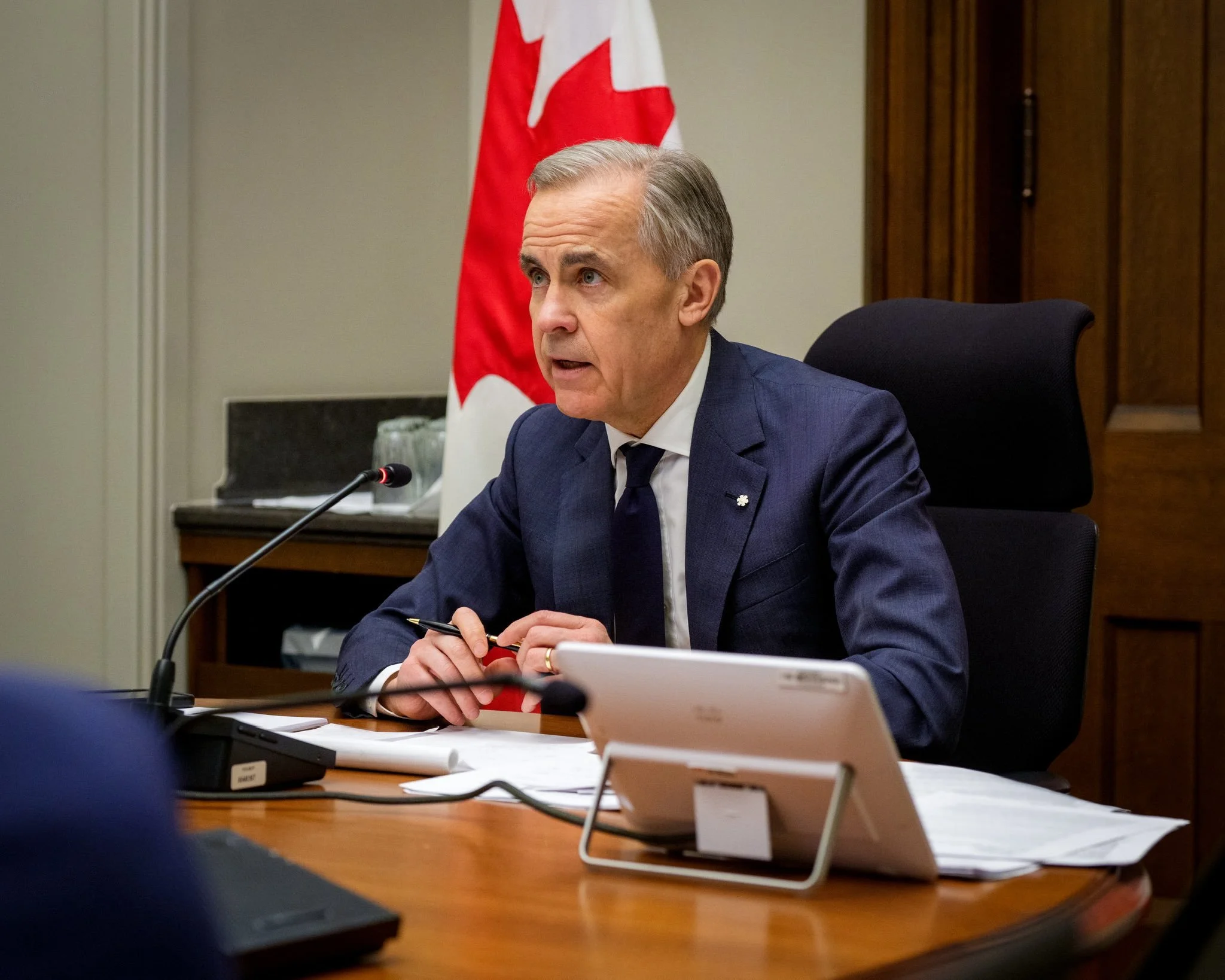
‘I spoke with G7 Leaders today on the situation in the Middle East. We condemned Iran’s strikes against civilians and civilian infrastructure, underscored the need to prevent further regional escalation, and focused on the global implications of this crisis,’ Prime Minister Mark Carney wrote on social media. / TWITTER PHOTO
Say what you will about President Donald Trump, there is no disputing his capacity and willingness to govern by distraction.
Time and again, he has diverted media and social media attention from his problems through the release of a “bright shiny thing,” uttering an “outrage, “ or picking a fight or otherwise generating a chaotic spectacle to divert attention from vulnerability.
Absent any fixed or coherent justification for his decision to join Israel in launching airstrikes against Iran, one can be excused for concluding that the president embarked on this course to divert attention from his tanking poll numbers over the state of the American economy and the rebuke of his core tariff agenda by the US Supreme Court.
If Trump had ever shown any attachment to a governing philosophy, acknowledged any restraint on his executive powers, or enacted an agenda apart from a naked pursuit of personal power, he might get the benefit of the doubt on Iran. But in the context of the rank ethical void that is “Trumpism,” it seems only reasonable to acknowledge the loathsome possibility that he sees this adventure — with its attendant death, destruction, and at best uncertain geopolitical consequences in a famously unstable region — as just one more bright shiny thing.
Accepting the world as it is, not as we would like it to be
Whatever the President’s motives, Prime Minister Mark Carney has clearly viewed the attack on Iran not so much as a distraction as an object lesson confirming the indictment he made of the now-ruptured rules-based international order in his now-famous speech at the World Economic Forum in Davos.
There, he talked of the “the beginning of a harsh reality where geopolitics — where the large, main power, is submitted to no limits, no constraints.” More significantly, he laid out an approach he called “principled and pragmatic:”
“Principled in our commitment to fundamental values: sovereignty and territorial integrity, the prohibition of the use of force except when consistent with the UN Charter, and respect for human rights. Pragmatic in recognising that progress is often incremental, that interests diverge, that not every partner will share all of our values. We are engaging broadly, strategically, with open eyes. We actively take on the world as it is, not wait for a world we wish to be.”
Since the air campaign began, by his actions and comments, Carney has moved, if not always in a sure-footed way, to sidestep this bright shiny thing.
Upon news of the airstrikes, Carney said “Canada supports the United States acting to prevent Iran from obtaining a nuclear weapon and to prevent its regime from threatening international peace and security … We do, however, take this position with regret because the current conflict is another example of the failure of the international order.” He has added “Prima facie, it appears that these actions are inconsistent with international law.”
Joining French President Emmanuel Macron, the Prime Minister “condemned Iran’s strikes against civilians and civilian infrastructure and underscored the need to prevent further regional escalation.”
He has also called for a de-escalation of hostilities. “And before we get there, there needs to be the ending of targeting civilians, civilian infrastructure. Those are necessary conditions for a ceasefire to exist.” And he has made clear that “Canada is not participating in the United States and Israeli offensive and will never participate in it.”
While his public statements have been justifiably criticized for not being clear and for herky-jerky changes in emphasis, they speak to a Prime Minister who refuses to be dragged into the conflict. Having classified Iran as a “state sponsor of terroism,” he knows Canada has no interest in opposing a campaign launched by a President who is a world-class holder of grudges.
At the same time, Carney has no reason to trust in President Trump’s motives or endgame. So he tied Canada’s support of the attacks to the extent to which they provably accomplish the multi-decade ambition of the international community to end Iran's nuclear weapons program.
Putting flesh on the bones of the Davos agenda
Above all, the Prime Minister has refused to be diverted from the bedrock agenda laid out at Davos to diversify Canada’s economic and political relationships as a hedge against precisely the kind of more-or-less unilateral great-power action that the attack on Iran very much looks like. Carney continues on the track of “prioritising broad engagement to maximise our influence, given the fluidity of the world order, the risks that this poses, and the stakes for what comes next.”
It is instructive in this regard to note that the Prime Minister's first statements about the airstrikes were made on the margins of meetings with Australian Prime Minister Anthony Albanese, where they formalized new cooperation agreements on critical minerals, defence, energy, and AI as part of their strategic partnership.
He next spoke to the media about the airstrikes from Tokyo, Japan, where he announced a Comprehensive Strategic Partnership with Japan covering defence, energy, trade, technology, and innovation.
In the weeks leading up to the outbreak, and following on January’s a new strategic partnership with China, Carney signed multiple agreements with India, including terms of reference for launching Comprehensive Economic Partnership Agreement (CEPA) negotiations, a long-term uranium supply deal, and an MOU on critical minerals value chains.
So whatever the US and Israel say they achieve with the airstrikes, the Prime Minister will not be swayed from putting more flesh on the bones of Davos by knitting together a network of countervailing economic and political ties that will hedge Canada's risk from this and the next eruption of great-power pique.
When it comes to Iran, others may dwell on the conflict’s violation of international law, or the failure of the Prime Minister to get a vote from Parliament before stating the Canadian position. Still, others will hope that the airstrikes finally furnish that long hoped for moment when Trump may have gone to far
Hard as it may sound in the context of the myriad negative economic and political side effects it has had so far, the Prime Minister will be content to speak and act like the leader he is: someone who accepts the world as it is rather than how he might like it to be, and who will not be distracted by the bright shiny thing.