Red tape reduction bill makes it easier for Canadians, businesses to access government: TBS president Ali
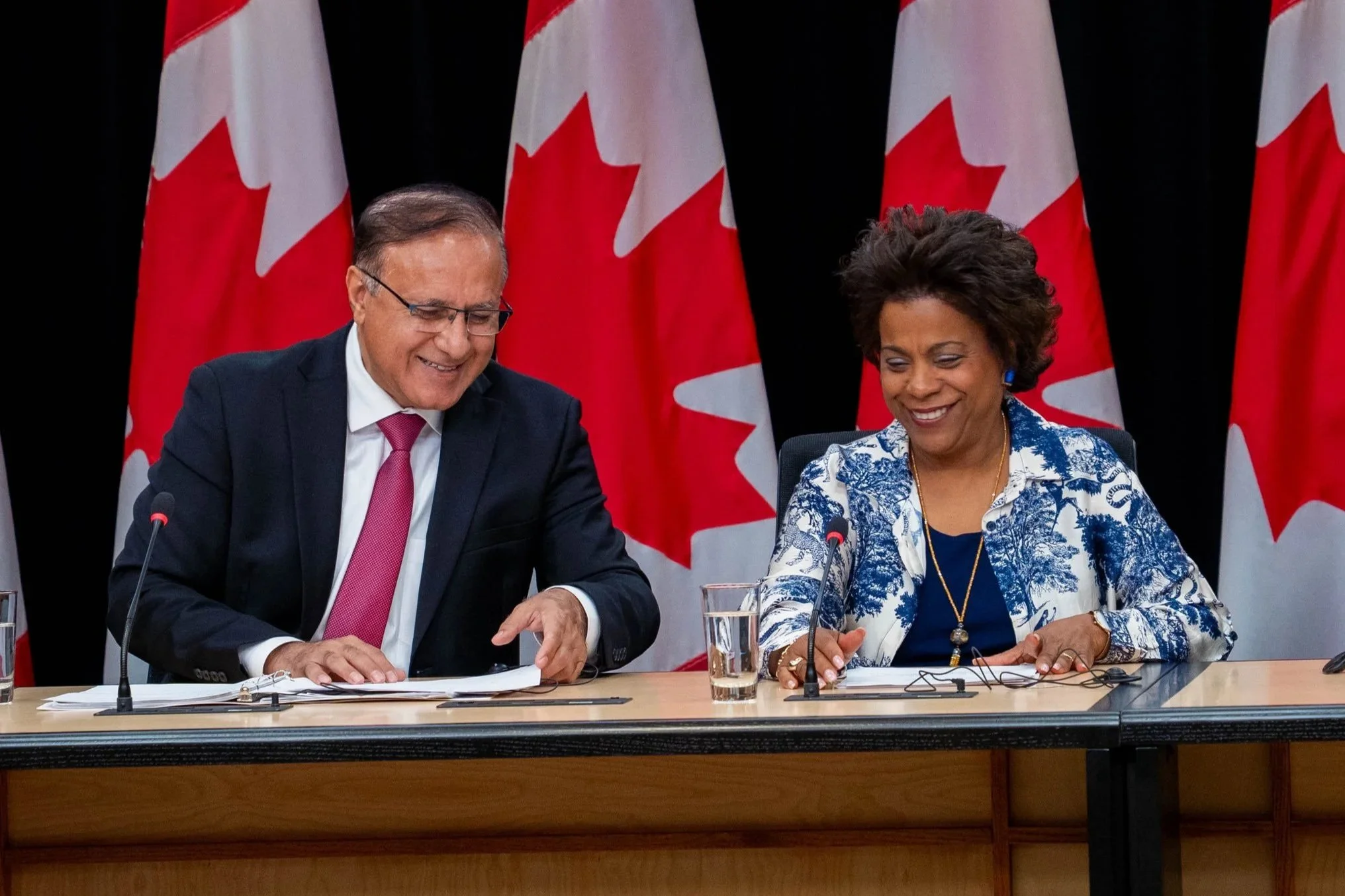
Treasury Board President Shafqat Ali and Health Minister Marjorie Michel, pictured at a press conference introducing Bill S-7, the Cutting Red Tape for All Canadians Act. / TWITTER PHOTO
The federal government’s red tape reduction bill proposes to simplify regulations, reduce paperwork, modernize government processes, and give ministers and regulatory agencies more flexibility to make decisions, says Treasury Board President Shafqat Ali.
“The changes are practical and focused on making it easier for Canadians and businesses to meet requirements and access government. These include greater use of digital tools and electronic communications, as well as simpler, more efficient compliance processes,” Ali said during a press conference to introduce Bill S-7, the Cutting Red Tape for All Canadians Act.
Ali said that of the nearly 500 proposals identified through the red tape review, some require legislative amendments rather than regulatory changes, making Bill S-7 a more efficient means of implementing reforms across multiple departments. “This bill helps deliver on the government's commitment to cut red tape,” he said.
Ali said the changes are expected to save business and government $264 million over 10 years. To continue removing unnecessary barriers that emerge over time, he said the federal government plans to introduce similar red tape-reduction legislation “on a regular basis” going forward.
David Pierce, Vice President, Government Relations for the Canadian Chamber of Commerce, said the bill is a “much-needed recalibration” of government’s interaction with industry.
"Every year, Canadian businesses spend more than 3.1 million hours filling out forms, navigating government requirements, uploading documents, and complying with rules compounded with overlapping rules. On the other side, public servants spend countless hours reviewing and processing those submissions. It's a never-ending cycle that consumes time and money that could otherwise be spent building businesses and growing our economy. This is what industry refers to as unnecessary government red tape,” Pierce said in a statement. “We applaud the President of the Treasury Board for advancing this legislation and, importantly, for signalling that regulatory modernization must be an ongoing priority, not a one-time exercise.”
When asked about industry’s influence on proposed reforms, Ali replied that the changes would not weaken existing safeguards concerning accountability, health, safety, privacy or environmental protection. The bill also introduces new measures to protect the environment, including new fines for polluters and more effective methods for conducting environmental inspections. He also highlighted cooperation with provincial and territorial governments to reduce regulatory burdens, support economic growth and improve service delivery.
Health Minister Marjorie Michel highlighted changes allowing Health Canada to rely on trusted international regulatory agencies to accelerate drug approvals, alongside measures to expand electronic services, simplify Canadian Food Inspection Agency (CFIA) operations and modernize waste management procedures.
Agriculture and Agri-Food Minister Heath MacDonald said the bill would streamline premarket assessments and accelerate approvals for seeds, feeds, fertilizers and veterinary biologics. He also highlighted measures to reduce administrative burdens on agricultural producers, support intergenerational farm transfers and eliminate longstanding age restrictions.
When asked how Bill S-7 would improve access to domestic and international markets for agricultural producers, MacDonald pointed to the digitization of phytosanitary certification and greater regulatory alignment with trading partners, citing a recent agreement with Vietnam. He also highlighted restrictions preventing Canadian farmers from using agricultural products already approved in countries such as the United States, despite food produced using those products being permitted for import into Canada.
The bill also proposes giving federal ministers additional authority to control development near airports, respond to marine security threats, restrict where vessels can travel, and make exceptions to certain border laws.